
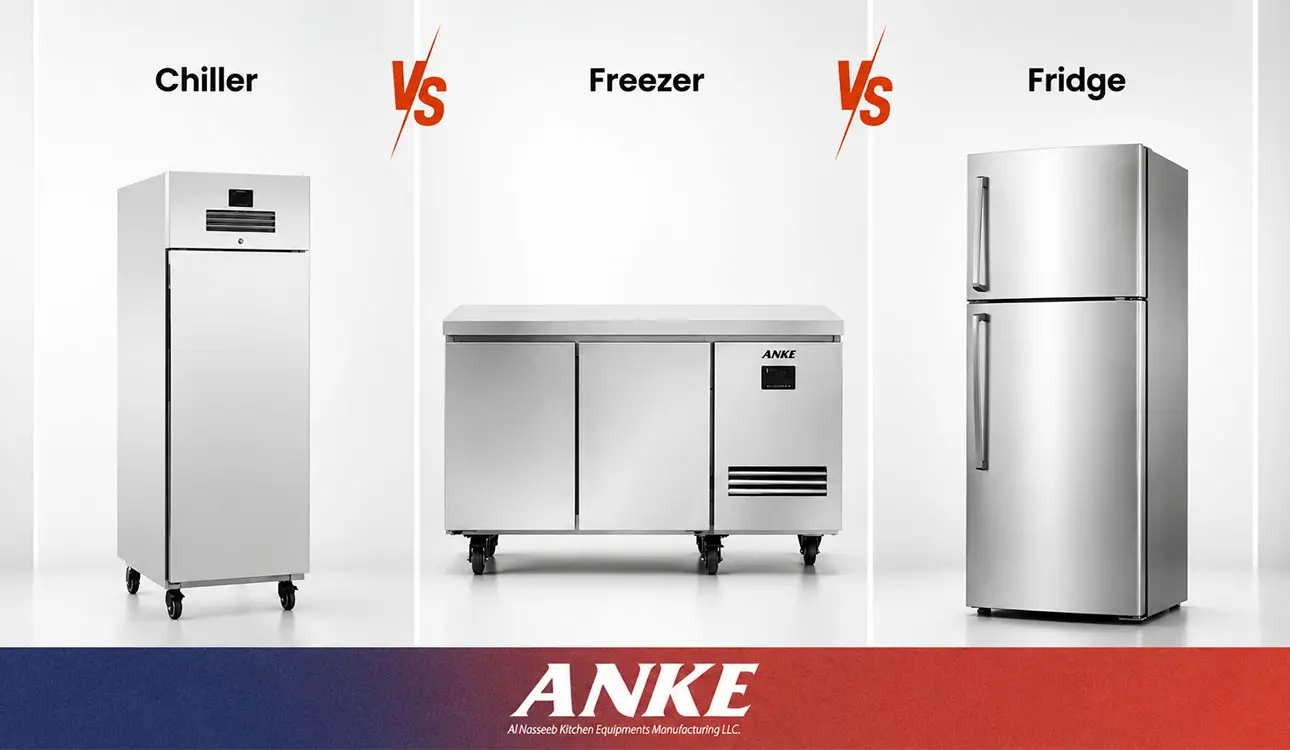
A commercial chiller holds food between -2C and +10C without freezing it. A household fridge holds around 3C to 5C. A commercial freezer holds -18C to -22C. The temperature is the visible difference. The real difference is how hard each machine works to hold that temperature and that is what decides your electricity bill, your compressor life, and where in the kitchen the unit can actually stand.
If you have three quotes in front of you and cannot work out why the freezer costs so much more to buy and to run than the chiller sitting beside it, you are not alone. Most suppliers quote the holding temperature and stop there. The numbers that actually explain the gap sit further down the spec sheet, and they are almost never explained.
At ANKE, we walk UAE commercial kitchens through this decision every week. This guide covers what separates a chiller from a fridge, why a freezer draws four times the electricity in an identical cabinet, why ambient temperature ratings differ across a single manufacturer’s own range, and how to work out which combination of commercial refrigeration units your kitchen actually needs.
Is a Chiller the Same as a Fridge?
No. A commercial chiller and a household fridge do the same basic job, but they are built to different standards for completely different workloads.
A household fridge is designed for a home kitchen where the door opens a few times a day. A commercial chiller is designed for a service line where the door opens dozens of times an hour, in a room that can sit well above 40C near the cooking equipment.
The differences that matter on a spec sheet:
- Compressor duty: a commercial compressor is rated for continuous heavy cycling. A household compressor is not.
- Ambient rating: commercial units carry a published ambient temperature rating. Household units generally do not publish one at all.
- Insulation and door seals: commercial cabinets use thicker insulation and heavier gaskets to survive constant door traffic.
- Temperature control: commercial units use electronic controllers that hold a set point tightly instead of drifting between cut-in and cut-out.
- Material: commercial cabinets are built in 304 grade stainless steel inside and out, which stands up to daily cleaning chemicals.
Pro Tip: If a supplier offers a household-style unit for a commercial kitchen, ask for the ambient temperature rating in writing before anything else. If there is no published rating, the unit was never designed for a UAE kitchen heat load.
What Is a Commercial Chiller and What Temperature Should It Hold?
A commercial chiller is a refrigeration unit that holds food cold without freezing it, slowing bacterial growth while keeping texture and moisture intact.
The band varies slightly depending on what the cabinet is built for. Across the ANKE chiller range:
- Upright, under counter, and preparation chillers: -2C to +10C
- Lowboy chillers: +2C to +8C
- Bottle coolers: 0C to +8C
- Table top saladettes: 0C to +10C
Within that band, different products have different targets:
| Food type | Recommended holding temperature |
|---|---|
| Dairy (milk, cheese, yogurt) | 2C to 4C |
| Fresh red meat | 0C to 4C |
| Seafood | 0C to 4C |
| Fruit and vegetables | 4C to 8C |
| Beverages | 3C to 6C |
Pro Tip: Consistency matters more than the number on the dial. A cabinet that holds 4C steadily through a lunch rush preserves food better than one averaging 3C while swinging between 1C and 7C every time the door opens.
What Is a Commercial Freezer and Why Does It Work Harder?
A commercial freezer holds food at -18C to -22C, cold enough to stop bacterial activity almost entirely and extend storage from days to months.
Here is the part most guides leave out. To hold -18C inside the cabinet, the refrigerant itself has to run far colder than that. In the ANKE under counter range, the chiller runs a -10C evaporating temperature and the matching freezer runs -35C. Same cabinet, same footprint, same doors, same worktop. A 25 degree difference in how cold the refrigerant has to get.
That one number explains almost everything else about the machine:
- A larger compressor: considerably more work per cycle to reach and hold -35C.
- Thicker insulation: a bigger gap against a 43C kitchen means more heat constantly trying to get in.
- More waste heat: the under counter freezer rejects 975 W of heat against the chiller’s 613 W, in an identical cabinet.
- Higher electrical load: 0.75 kW against 0.2 kW on the same platform.
Pro Tip: When you compare two quotes, look for evaporating temperature and heat rejection, not just the holding range. Those two numbers tell you how hard the machine will work in your kitchen, which is what decides running cost and compressor life.
Chiller vs Fridge vs Freezer: The Complete Comparison
Most comparison guides put two of these side by side. Here are all three, including the engineering figures that usually go unmentioned.
| Commercial chiller | Household fridge | Commercial freezer | |
|---|---|---|---|
| Holding temperature | -2C to +10C | About 3C to 5C | -18C to -22C |
| Evaporating temperature | Around -10C | Not published | Around -35C |
| Heat rejected | 613 W | Not published | 975 W |
| Electrical load | 0.2 kW | Not published | 0.75 kW |
| Annual consumption | About 602 kWh | Not comparable | About 2,496 kWh |
| Storage duration | Days | Days | Weeks to months |
| Built for | Continuous commercial duty | Occasional home use | Continuous commercial duty |
| Ambient rating | Published, 32C or 43C | Rarely published | Published, 32C or 43C |
Customers judge freshness visually, not by checking dates. Surface moisture loss as low as 3% creates a dull, dry appearance that reads as old meat. An ANKE meat display counter with built-in humidity control and natural white LED maintains visual freshness throughout the trading day, so your product looks as fresh at closing time as it did at opening.
The chiller and freezer figures above are taken from two door under counter cabinets of identical size, so they are a like for like comparison rather than an industry average.
Why Does a Freezer Cost Four Times More to Run Than a Chiller?
Because it is fighting a much larger temperature gap every hour of the day, and the electricity bill shows it clearly.
Take two doors under counter cabinets from the ANKE range. Same width, same depth, same height, same doors. Only the refrigeration system differs:
- Chiller: about 602 kWh per year
- Freezer: about 2,496 kWh per year
That is just over four times the annual consumption for the same cubic space in the same room. Across a kitchen running several units, that becomes a real line item rather than a rounding difference.
Three things widen or narrow that gap:
- Door opening frequency: every opening dumps cold air out and pulls warm, moist air in.
- Placement: a unit standing beside a fryer or oven works harder every hour of service.
- Condenser condition: a coil coated in grease cannot reject heat, so the compressor runs longer to achieve the same result.
Pro Tip: Specify a freezer only where you genuinely need frozen holding. Kitchens routinely buy freezer capacity to solve a storage space problem, then pay four times the running cost to hold product that would have been perfectly fine in a chiller.
Why Do Ambient Temperature Ratings Differ Across the Same Range?
The ambient rating is the room temperature a unit is engineered to work in while still holding its internal set point. It is not the same as the internal temperature, and it is the number most buyers never think to ask for.
ANKE publishes both ratings across the range, because different cabinets are built for different positions in a kitchen:
- Rated for 43C ambient: upright chillers and freezers, under counter chillers and freezers, lowboy chillers and freezers, and bottle coolers.
- Rated for 32C ambient: preparation chillers, table top saladettes, and blast freezers.
The distinction is practical rather than marketing. A 43C rated cabinet is built to survive a position on a hot line or in an unconditioned back of house area through a UAE summer. A 32C rated cabinet is built for an air conditioned working area, which is where a prep station or a garnish rail normally sits anyway.
Pro Tip: Ask every supplier for the ambient rating in writing, then match it to where the unit will actually stand. A cabinet rated for a temperate climate placed next to a UAE fryer line will run continuously, cost more every month, and reach the end of its compressor life years early.
Where Does Each Unit Type Belong in Your Kitchen?
The right cabinet depends on where it stands and how often someone reaches into it. Each type in the ANKE range solves a different placement problem.
Upright chillers and freezers: tall reach-in cabinets holding up to 1,017 litres, for bulk storage in a store room or back area. See the upright chiller and upright freezer.
Under counter chillers and freezers: 900mm to 1,800mm wide at 850mm counter height with a usable stainless worktop, built into the counter run. See the under counter chiller and under counter freezer.
Lowboy chillers and freezers: 650mm high drawer bases holding 155 to 305 litres, low enough for counter top cooking equipment to sit above them. See the lowboy chiller and lowboy freezer.
Preparation chiller: an elevated GN 1/3 pan rail at 1,070mm with a refrigerated cabinet below, built for pizza and sandwich assembly. See the preparation chiller.
Table top saladette: a refrigerated pan rail only 270mm high holding 45 or 65 litres, for a garnish station with no floor space to spare. See the table top saladette.
Bottle cooler: one to three heated glass doors holding up to 295 litres, for beverage service behind a bar. See the bottle cooler.
Blast freezer: five or ten tray capacity for driving cooked food down fast. See the blast freezer.
Pro Tip: Most kitchens do not have to choose between these. A typical restaurant runs upright storage at the back, under counter units on the line, and one specialist cabinet for its highest volume station.
What Is the Food Safety Danger Zone, and Where Does a Blast Freezer Fit?
The food safety danger zone is 5C to 60C, the band where bacteria multiply fastest. Every chiller and freezer in a commercial kitchen exists to keep food outside that band. A blast freezer exists to move food through it quickly.
A standard chiller or freezer is built to hold cold that is already there. It is not built to remove heat from hot food. Loading a hot tray into an ordinary freezer raises the temperature of the entire cabinet and puts everything else stored in it at risk at the same time.
The difference in refrigeration power is stark:
- Under counter chiller: 350 W of refrigeration
- Under counter freezer: 550 W
- Ten tray blast freezer: 2,400 W
The ANKE blast freezer operates from +3C down to -40C and handles 20 to 40 kg of cooked food per cycle. It is also the one cabinet in the range that uses R404A refrigerant, with a global warming potential of 1,900, rather than the R290 used across the rest of the range, which has a GWP of 3. Blast duty means running at a -35C evaporating temperature under heavy continuous load, and that is the tradeoff it demands.
There is a second reason speed matters, beyond safety. Slow freezing grows large ice crystals that rupture the structure of the food, so moisture and texture are lost the moment it thaws. Fast freezing grows much smaller crystals, which is why blast frozen product plates better than product frozen slowly in a storage cabinet.
Pro Tip: A blast freezer solves a cooling speed problem, not a storage capacity problem. Once the cycle finishes, the food still moves into a normal chiller or freezer for ongoing storage.
Which Foods Belong in a Chiller and Which Belong in a Freezer?
Shelf life decides this more than food type does. The same cut of chicken belongs in a chiller if it is cooking today and a freezer if it is inventory for next month.
Chiller, for product used within days:
- Fresh fruit and vegetables
- Dairy products
- Beverages
- Fresh meat and seafood for near term use
- Cakes, pastries, and desserts
Freezer, for product held for weeks or months:
- Raw meat, poultry, and seafood held as bulk inventory
- Ice cream and frozen desserts
- Frozen vegetables and fruit
- Batch cooked meals portioned for later service
Some items never belong in a freezer regardless of how long they would otherwise keep. Lettuce, cream sauces, and most soft prepared salads lose their structure once the ice crystals inside them melt, so they arrive on the plate watery no matter how carefully they were frozen.
Pro Tip: Fresh red meat holds at 0C to 4C. Store it in sealed containers on a lower shelf so nothing can drip onto ready to eat product below it.
Common Mistakes When Choosing Refrigeration for a UAE Kitchen
These six come up repeatedly in kitchens across Dubai, Sharjah, and Ajman, and every one of them is avoidable at the specification stage.
- Ignoring the ambient rating. Equipment built for a temperate climate works harder every hour in a UAE kitchen. Check the ambient rating, not only the internal range.
- Assuming every unit needs a clearance gap behind it. ANKE under counter units and bottle coolers are front breathing, drawing and venting air at the front grill, so they sit flush in a counter run with no gap behind. Rear breathing units genuinely do need that clearance. Check which type you are buying before you plan the layout, because the difference changes how much counter length you actually get.
- Buying freezer capacity to solve a chiller space problem. Freezing extends shelf life. It does not create storage space, and it costs roughly four times as much to run.
- Undersizing, then overpacking. A cabinet packed tight blocks the internal airflow, which creates warm pockets no thermostat can correct.
- Placing a unit next to a heat source without checking its rating. A 32C rated cabinet standing beside a fryer line is working outside what it was designed for, every service.
- Skipping condenser cleaning. A grease coated condenser is the single most common cause of premature compressor failure in a commercial kitchen. Every one to three months is the working interval.
Find the Right Chiller and Freezer Combination with ANKE
Choosing between a chiller, a fridge, and a freezer comes down to three questions: how cold the product needs to be held, how long it needs to be held for, and how hot the room around the cabinet gets during service.
ANKE has manufactured commercial refrigeration in the UAE since 1997, building in 304 grade stainless steel from our facility at 105 Amr Ibn El Aas Street, Ajman Industrial 1. Every cabinet in the range carries a published ambient temperature rating, and custom sizes are built to order where a standard configuration does not fit the space.
Whether you are outfitting a new restaurant, upgrading a bakery, or building out a bar service counter, contact us today for a free consultation and we will help you work out the right combination for your kitchen.
Frequently Asked Questions
Is a chiller the same as a refrigerator?
No. A commercial chiller holds a controlled -2C to +10C band and is built for continuous commercial duty. A household refrigerator holds roughly 3C to 5C and is built for occasional home use.
Which uses more electricity, a chiller or a freezer?
A freezer. In the ANKE two door under counter range, the chiller uses about 602 kWh per year and the matching freezer about 2,496 kWh, just over four times more in the same cabinet size.
Can I store raw meat in a chiller?
Yes, for near term use. Hold fresh red meat at 0C to 4C in sealed containers on a lower shelf to prevent cross contamination with ready to eat product.
What temperature is the food safety danger zone?
It is 5C to 60C. Bacteria multiply fastest in that band, which is why cooked food needs to pass through it quickly rather than cooling slowly on a bench.
Do I need a blast freezer?
Only if your kitchen batch cooks and needs hot food brought down quickly before storage. A blast freezer solves a cooling speed problem, not a storage capacity problem.
What refrigerant do commercial chillers and freezers use?
ANKE uses R290 across most of the range, a natural refrigerant with a global warming potential of 3. Blast freezers use R404A, with a GWP of 1,900, because blast duty requires it.
What does the ambient temperature rating mean?
It is the room temperature the cabinet is engineered to work in while still holding its internal set point. ANKE rates uprights, under counters, lowboys, and bottle coolers for 43C, and preparation chillers, saladettes, and blast freezers for 32C.
Can I use a household fridge in my restaurant?
It is not recommended. Household units are not built for the compressor duty, insulation, door traffic, or ambient heat load a commercial kitchen produces.
