
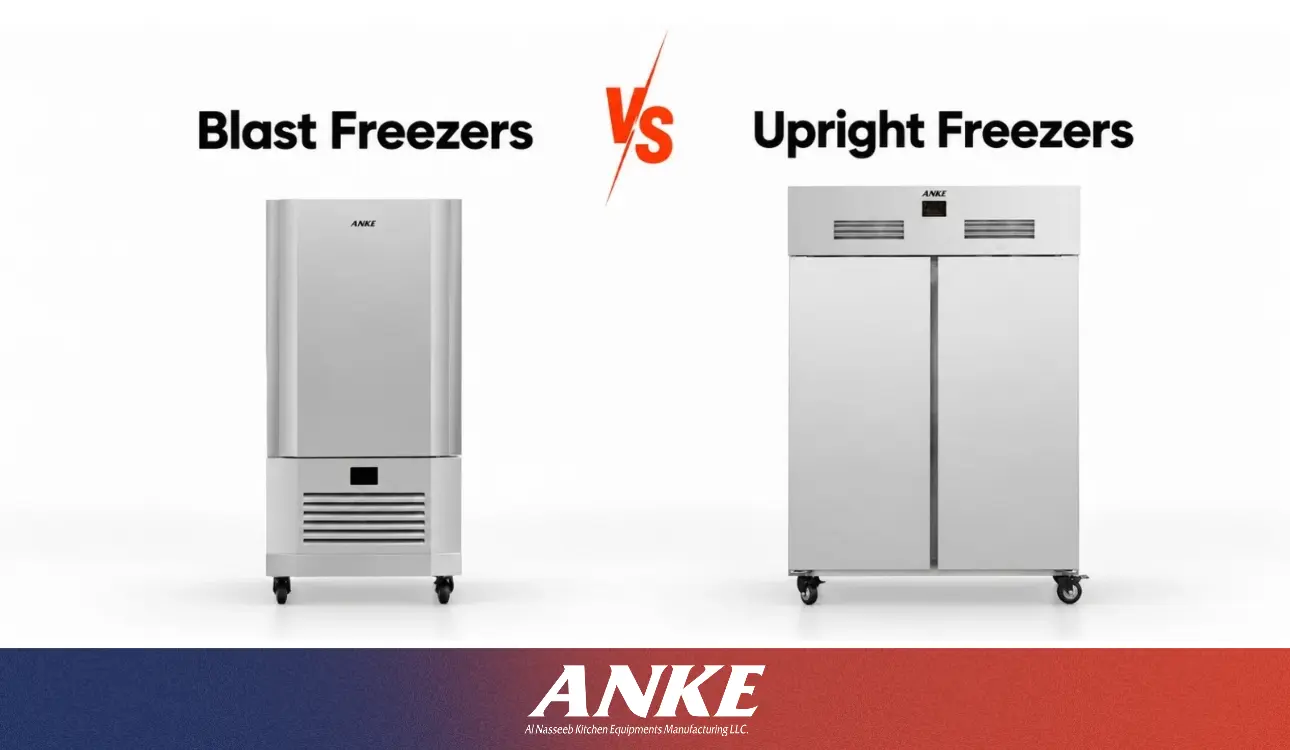
A blast freezer freezes newly prepared food quickly. An upright freezer stores food that is already frozen.
That is the main difference.
ANKE blast freezers operate from +3°C to -40°C and are sized by the amount of food they can process in one cycle.
ANKE upright freezers operate from -18°C to -22°C and are sized mainly by storage volume, shelves and door configuration.
A restaurant that receives frozen products may only need an upright freezer. A hotel, catering kitchen or central kitchen that freezes its own food may need a blast freezer and an upright freezer.
What Is the Difference Between a Blast Freezer and an Upright Freezer?
The two freezers perform different jobs.
| Attribute | Blast Freezer | Upright Freezer |
| Main purpose | Rapidly freeze new batches | Store frozen stock |
| ANKE temperature range | +3°C to -40°C | -18°C to -22°C |
| Main sizing method | kg per cycle | litres and shelves |
| ANKE capacities | 20 kg or 40 kg per cycle | 450 L or 1017 L |
| Storage format | 5 or 10 trays | 4 or 8 GN 2/1 shelves |
| Ambient rating | 32°C | 43°C |
| Main kitchen role | Production process | Frozen storage |
| Typical users | Catering, hotels, central kitchens | Restaurants, hotels, cafés, catering kitchens |
Simple rule:
Blast freezer = process a new batch.
Upright freezer = hold frozen inventory.
This distinction should come before price, litres or cabinet size.
What Is a Blast Freezer?
A blast freezer removes heat from food much faster than a normal frozen-storage cabinet.
ANKE offers two blast-freezer models:
- BCF5: 5 trays, 20 kg per cycle, 90 L
- BCF10: 10 trays, 40 kg per cycle, 290 L
Both models use 400 × 600 mm trays. Both models operate from +3°C to -40°C. Both models are rated for 32°C ambient conditions.
A commercial kitchen can use a blast freezer when it:
- cooks in batches
- freezes prepared food
- prepares catering orders in advance
- processes bakery products
- freezes meat or seafood
- produces food centrally for later use
The key buying question is not:
How much frozen food do I store?
The better question is:
What is the largest batch I need to freeze at one time?
Buyers who need this function can review the ANKE commercial blast freezer range.
What Is an Upright Freezer?
An upright freezer is a frozen-storage cabinet.
It keeps already-frozen products organised on shelves and ready for access during service.
ANKE offers two upright-freezer models:
- UPF1: single door, 450 L, 4 shelves
- UPF2: double door, 1017 L, 8 shelves
Both models operate from -18°C to -22°C. Both models use GN 2/1 shelving. Both models are rated for ambient temperatures up to 43°C.
An upright freezer suits:
- frozen meat
- frozen seafood
- frozen bakery products
- prepared frozen meals
- packaged frozen ingredients
- stock waiting for future service
The buying question is:
How much frozen stock must the kitchen hold and access?
Buyers can compare the ANKE commercial upright freezer in single-door and double-door formats.
Can an Upright Freezer Replace a Blast Freezer?
An upright freezer should not replace a blast freezer when the kitchen needs rapid batch freezing.
The two machines handle different loads.
A blast freezer receives food that still contains significant heat. The blast freezer removes that heat quickly.
An upright freezer receives products that are already frozen. The upright freezer maintains the required frozen-storage temperature.
The ANKE specifications show this difference clearly.
The BCF10 blast freezer provides 2400 W of refrigeration power. The ANKE upright freezer provides 765 W.
The higher figure does not mean the blast freezer is simply a “better freezer.”
It means the blast freezer performs a more demanding pull-down job.
Why Does Rapid Freezing Matter for Food Quality?
Food quality can change during freezing.
Slow freezing can create larger ice crystals inside food. Those crystals can damage food structure and affect texture after thawing.
Rapid freezing reduces the time food spends moving through the freezing phase.
For a commercial kitchen, that can matter when freezing:
- cooked food
- bakery items
- meat
- seafood
- prepared meals
- catering batches
This is why the blast freezer belongs to the production process.
The upright freezer belongs to the storage process.
The SERP you supplied also shows that Google currently associates blast-freezing comparisons with rapid temperature reduction, food quality, batch cooking and long-term storage decisions.
How Would a Catering Kitchen Use a Blast Freezer and Upright Freezer?
Consider an illustrative 30 kg catering batch.
The kitchen prepares the batch today. The kitchen needs to freeze the food and store it for later use.
Step 1: Size the Blast Freezer by the Largest Batch
The ANKE BCF5 processes up to 20 kg per cycle.
A 30 kg batch exceeds that single-cycle capacity.
The BCF10 processes up to 40 kg per cycle.
The BCF10 therefore becomes the stronger starting point when the kitchen needs to process the full illustrative 30 kg batch in one rated cycle.
This gives buyers a useful rule:
Size a blast freezer by the largest batch you need to freeze at one time.
Do not size it only from total daily production.
A kitchen can produce 100 kg per day but freeze that production in several smaller batches.
Step 2: Freeze the New Batch
The kitchen loads the prepared food into the blast freezer.
The BCF10 provides 10 tray positions.
The kitchen should load the product according to its own validated food-production process. Food type, thickness, loading and starting temperature can affect freezing performance.
ANKE’s specification gives the equipment range and rated capacity. It does not state one universal freezing time for every food product.
Step 3: Transfer the Frozen Batch to Storage
After the required freezing process is complete, the kitchen moves the frozen product into an upright freezer.
The buying question now changes.
For the blast freezer, the question was:
How many kilograms must I process?
For the upright freezer, the question becomes:
How much frozen inventory must I hold?
That produces the second sizing rule:
Size an upright freezer by frozen-stock volume, shelf requirements and access frequency.
Do You Need Both a Blast Freezer and an Upright Freezer?
Some kitchens need both machines.
The workflow is simple:
Prepare → Blast Freeze → Frozen Storage → Service or Dispatch
A blast freezer processes the new batch.
An upright freezer holds the completed frozen stock.
A restaurant that buys all frozen products from suppliers may not need a blast freezer.
A catering company that freezes its own production may need both.
A central kitchen that prepares food for several outlets may also need separate processing and storage capacity.
The decision should follow the food-production process.
Which Freezer Is Better for UAE Commercial Kitchens?
Neither freezer is universally better.
The kitchen must match the equipment to the job and installation environment.
One specification deserves special attention in the UAE:
ambient temperature rating.
The ANKE blast freezer is rated for 32°C ambient.
The ANKE upright freezer is rated for 43°C ambient.
These values describe the environment around the equipment. They do not describe the temperature inside the cabinet.
A blast freezer therefore needs careful placement if the proposed location is close to:
- ovens
- fryers
- grills
- cooking ranges
- other major heat sources
A buyer should always check two separate values:
- Internal operating temperature
- External ambient rating
For a wider explanation of refrigeration temperature bands, read ANKE’s chiller vs fridge vs freezer guide.
When Should You Choose a Blast Freezer?
Choose a blast freezer when your kitchen:
- freezes freshly prepared food
- works with production batches
- needs rapid freezing as part of the workflow
- operates a catering or banquet kitchen
- produces food centrally for later use
- needs tray-based batch processing
For ANKE, the starting choice is simple:
Up to 20 kg per cycle → BCF5
Up to 40 kg per cycle → BCF10
The final specification should still consider the product, process and installation conditions.
When Should You Choose an Upright Freezer?
Choose an upright freezer when your kitchen:
- mainly stores already-frozen products
- needs frequent shelf access
- needs organised vertical storage
- wants a single-door or double-door format
- requires 450 L or 1017 L of usable storage
- operates in demanding UAE back-of-house conditions
The UPF1 suits smaller frozen-storage requirements.
The UPF2 suits kitchens that need more shelf space and higher frozen-stock capacity.
If your decision is about the physical format of refrigeration rather than rapid freezing, ANKE also has separate comparisons for undercounter chiller vs lowboy chiller and undercounter chiller vs preparation chiller.
These articles answer different equipment-selection questions and keep each comparison focused.
What Should You Send ANKE Before Requesting a Quote?
Send five pieces of information:
- Largest batch size in kilograms
- Required frozen-storage volume
- Available kitchen dimensions
- Temperature conditions around the equipment
- Type of operation
The operation may be a:
- restaurant
- hotel
- catering kitchen
- bakery
- central kitchen
- food-production facility
These details help separate the freezing requirement from the storage requirement.
You can also review the full ANKE commercial refrigeration range for upright, undercounter, lowboy, preparation and blast-freezing formats.
Plan the Right Freezing Workflow with ANKE
A blast freezer processes new food batches.
An upright freezer stores frozen products.
The right commercial kitchen may need one machine or both.
ANKE manufactures commercial refrigeration for professional foodservice operations in the UAE.
Choose the ANKE commercial blast freezer when batch freezing is part of production.
Choose the ANKE commercial upright freezer when organised frozen storage is the main requirement.
For projects that need both rapid freezing and frozen holding, contact us with the batch size, storage requirement and kitchen layout. ANKE can then evaluate the processing requirement separately from the storage requirement.
Frequently Asked Questions
What is the main difference between a blast freezer and an upright freezer?
A blast freezer rapidly freezes newly prepared food. An upright freezer keeps food that is already frozen at a stable storage temperature.
Can an upright freezer replace a blast freezer?
Not when the kitchen requires rapid batch freezing. The upright freezer is designed mainly for frozen storage. The blast freezer is designed for rapid pull-down.
What temperature does an ANKE blast freezer reach?
ANKE blast freezers operate from +3°C to -40°C.
What temperature does an ANKE upright freezer hold?
ANKE upright freezers operate from -18°C to -22°C.
Is a blast freezer worth it for a commercial kitchen?
A blast freezer is useful when a kitchen regularly freezes freshly prepared batches. A kitchen that only stores products supplied already frozen may only need frozen-storage equipment.
How do I size a blast freezer?
Start with the largest batch that must be frozen in one cycle. ANKE offers 20 kg and 40 kg cycle capacities.
How do I size an upright freezer?
Start with the amount of frozen stock that must be held, the available floor space and the required shelf access.
Does a commercial kitchen need both?
It may. A kitchen that freezes its own production and then stores the frozen product can use a blast freezer for processing and an upright freezer for storage.
