
There is no standard size. The right commercial meat display for a Dubai butchery is set by five inputs: product range, peak trading volume, service format, staff access, and refrigeration layout. Wall length alone answers none of these.
Most first-time buyers measure the wall, pick the longest cabinet that fits, and assume the job is done. The cost of a sizing mistake is not paid at delivery. It is paid every trading day: a counter that looks half empty, staff who cannot restock during a rush, and a compressor drawing more power than the shop needs.
This guide covers the three layers of ANKE sizes around, why two counters of the same width hold different amounts of meat, why a bigger display rarely sells more, and the exact checks to run before you order.
At ANKE, we design and fabricate custom commercial meat displays for butcheries, supermarkets, and premium food retailers across Dubai and the UAE from our Ajman facility.
The Biggest Sizing Mistake in UAE Butcheries
The most common mistake is sizing the display around today’s stock instead of peak trading stock.
Most buyers size for an ordinary Tuesday. ANKE sizes for the busiest trading week of the year, because counters are replaced when a business outgrows them, not because they fail. A display built for average demand runs out of merchandising space within the first year, forcing a second cabinet or an early replacement.
The second mistake is assuming the full wall is usable. Columns, door swings, electrical isolators, drainage points, condenser ventilation, and customer circulation all reduce the installable length.
ANKE field note. Most customers calculate today’s stock. We calculate Eid stock. Your display should still look full during Ramadan and seasonal demand, not only on a quiet weekday.
The Biggest Sizing Mistake in UAE Butcheries
Every ANKE meat display is sized across three layers: physical footprint, merchandising capacity, and operational space.
Layer 1: Physical Footprint
Physical footprint is the floor space the cabinet occupies, including external width, depth, height, and clearance for delivery and installation. Measure wall length, usable depth, ceiling height, entrance width, and obstacle positions before requesting a quote.
A six-metre wall rarely gives six meters of display. A typical breakdown looks like this:
| Wall element (example) | Width |
| Full wall | 6000 mm |
| Door clearance | 900 mm |
| Structural column | 350 mm |
| Condenser ventilation | 250 mm |
| Usable display width | 4500 mm |
Layer 2: Merchandising Capacity
Merchandising capacity is the internal space customers actually see: shelf count, shelf depth, tray layout, and carcass-hanging height. External width does not reveal this. Glass panels, evaporators, drainage channels, and shelf brackets all consume internal volume, so two cabinets of equal width can hold very different amounts of product. See how custom fabrication maximises usable capacity.
Layer 3: Operational Space
Operational space is the area around the cabinet, not inside it. It covers staff working clearance behind the counter, customer circulation in front, condenser airflow for refrigeration performance, and service-panel access for the engineer. A counter that fills the floor plan but ignores this space creates problems in the first week of trading.
Meat is rarely the problem. The presentation usually is. When moisture, lighting, glass, and design work together, the display stops being equipment and becomes a sales system.
At ANKE, we fabricate commercial meat display counters in Ajman that keep your product looking fresh from the first customer to the last. Whether you run a premium butchery, a supermarket meat counter, or a hotel food retail concept. We design a unit that works for your space, your brand, and your product.
Contact us today for a free consultation; bring a photo of your current counter and we’ll walk you through what can be improved.
Why a Bigger Meat Display Does Not Sell More Meat
A bigger meat display does not automatically sell more meat, because customers buy on freshness, not cabinet length.
Shoppers read a full, well-stocked counter as fresh and fast-moving. They read a large, half-empty counter as slow or ageing stock. A correctly sized display that stays full through the trading day outsells an oversized one that is rarely filled. A simple comparison shows why:
| Display | Length | Typical fill | Customer read |
| Counter A | 6 m | around 55% full | Looks slow, empty gaps visible |
| Counter B | 4 m | around 95% full | Looks fresh and fast-moving |
Customers judge freshness visually, not by checking dates. Surface moisture loss as low as 3% creates a dull, dry appearance that reads as old meat. An ANKE meat display counter with built-in humidity control and natural white LED maintains visual freshness throughout the trading day, so your product looks as fresh at closing time as it did at opening.
How ANKE Sized the MLS Motor City Meat Display
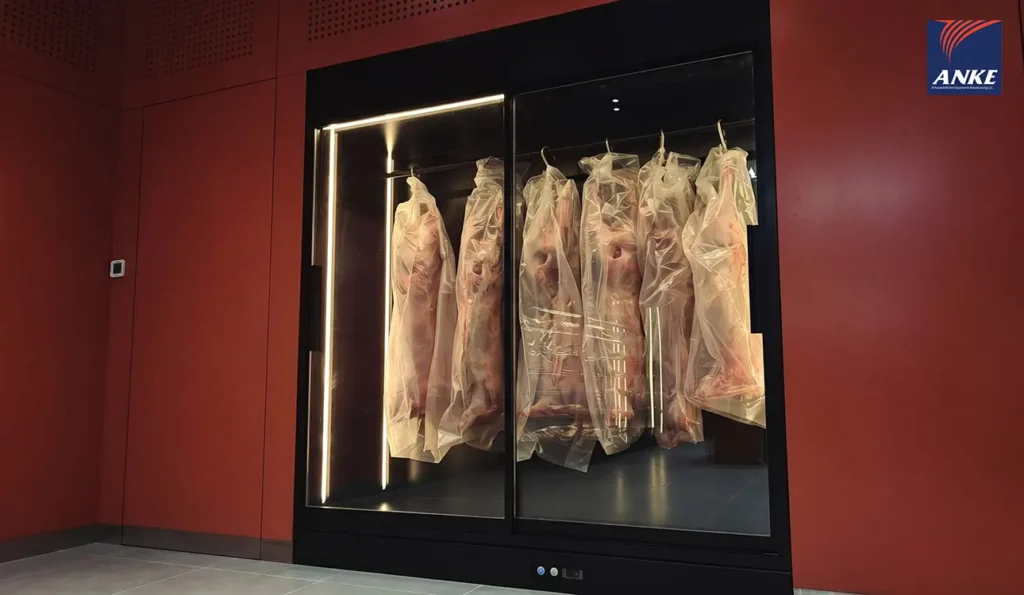
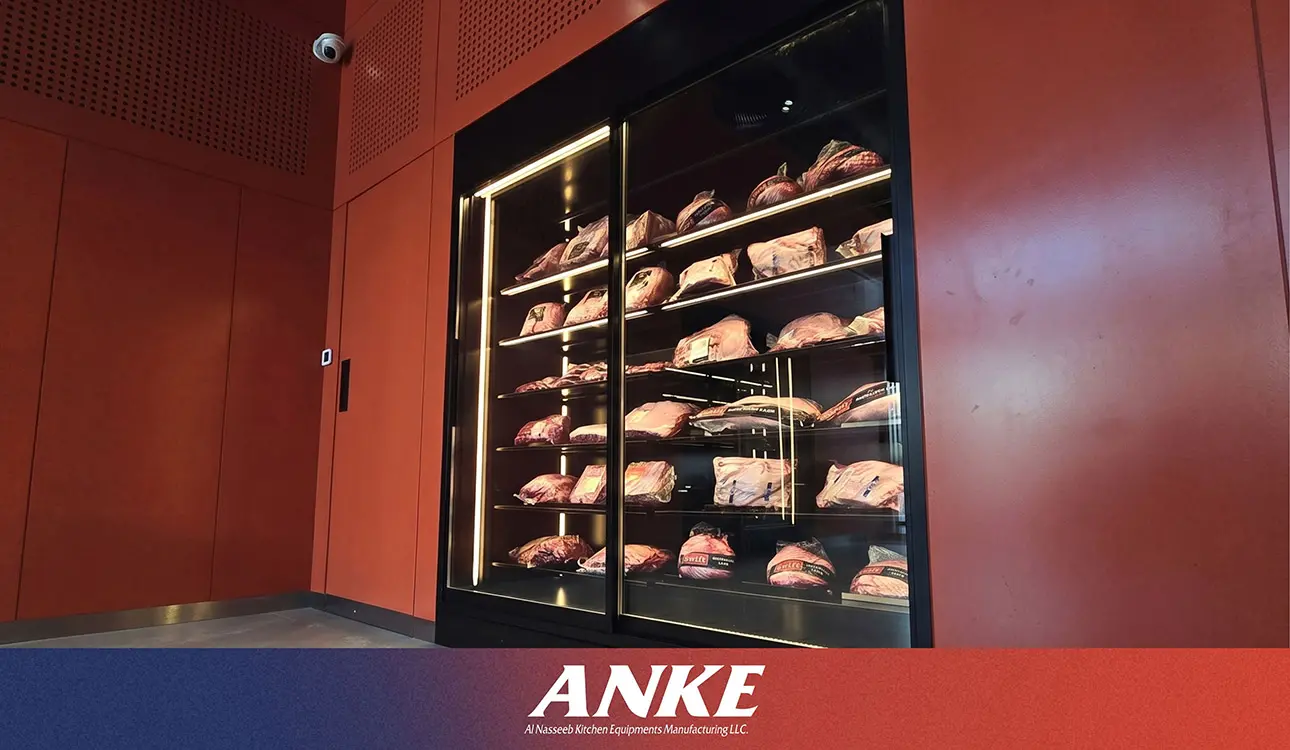
The MLS Butchery project in Dubai Motor City shows why one operation needed three display formats, not one long counter.
ANKE fabricated three cabinets for MLS: an upright multi-shelf display for packaged retail cuts, an upright display with a carcass-hanging section for whole carcasses, and a freestanding counter for customer-facing frontage. Each format was chosen for merchandising behaviour, not cabinet length. Packaged cuts need shelf visibility, whole carcasses need vertical clearance, and premium cuts sell better from an island shoppers can approach from several sides.
| Attribute | Detail |
| Project | MLS Butchery, Dubai Motor City |
| Formats | Upright multi-shelf, upright with carcass-hang, freestanding counter |
| Finish | Matte black powder coat |
| Glass | Argon-filled insulated glass |
| Interior | Modular, with interchangeable shelves and hanging components |
| Temperature | 0 to 4 degrees C for fresh red meat |
| Lead time | 4 to 6 weeks from the Ajman facility |
Buyer lesson: product format, staff access, and customer flow sometimes need a combination of displays, not one extended run. For help matching a format to your shop, read our guide to choosing a meat display.
The Three Questions ANKE Asks Before Fabrication
Before approving any fabrication drawing, ANKE asks every client three sizing questions.
- What is the busiest week of your year? We size for peak demand, not the average week.
- What is the largest product this cabinet will ever display? Whole lambs and large beef cuts need more depth than retail trays.
- Will this display still fit your business in three years? We design for expansion, so modules can be added instead of replacing the whole counter.
Three Things to Check Before You Order a Meat Display
Run these three checks before ordering a meat display, all from a sizing perspective.
- Measure the site, not the drawing. Verify every column, door, and duct on site, because real conditions differ from architectural plans.
- Size around the largest product. Design for the biggest cut you may display in five years, not today’s average tray.
- Finalise the counter before MEP work. Electrical isolators and drainage should follow the display layout, not the other way around.
Get Your Meat Display Sized by ANKE
ANKE International designs and fabricates custom commercial meat displays for butcheries, supermarkets, and premium food retailers across Dubai and the UAE. Every ANKE meat display includes:
- Custom sizing built to your exact floor plan at our Ajman facility, not a catalogue dimension.
- R290 refrigerant with Climate Class 5 compressors rated for UAE operating temperatures.
- Argon-filled insulated glass for product visibility and stable cooling.
- Humidity control to protect fresh red meat from drying during display.
- 304-grade stainless steel construction for hygiene and long service life.
- ISO 9001 and HACCP certification meeting Dubai Municipality food safety standards.
- 1-year manufacturer’s warranty on every custom display we ship.
- 4 to 6 week lead time from order to handover in Dubai.
For running-cost guidance, see our energy-efficient commercial refrigeration guide.
Commercial Meat Display Size FAQs
Is a bigger meat display always better?
No. A larger cabinet adds floor space, cleaning time, and energy use with no benefit when the shop cannot fill it. ANKE sizes each display around peak product presentation, not maximum cabinet length.
Can ANKE recommend a size from a floor plan?
Yes. ANKE reviews a floor plan, store photos, and a product list before recommending dimensions. A site visit is not required to start the design.
Why do two displays of the same width hold different amounts of meat?
Internal components consume usable space. Glass, evaporators, drainage channels, and shelf brackets all reduce product area. External width measures floor space, not capacity.
What temperature should a commercial meat display run at?
ANKE sets custom meat displays to hold fresh red meat at 0 to 4 degrees C, meeting UAE food safety standards.
Can one display hold both shelved cuts and whole carcasses?
Yes. ANKE builds modular displays with interchangeable shelving and carcass-hanging sections, as used on the MLS Motor City project.
