
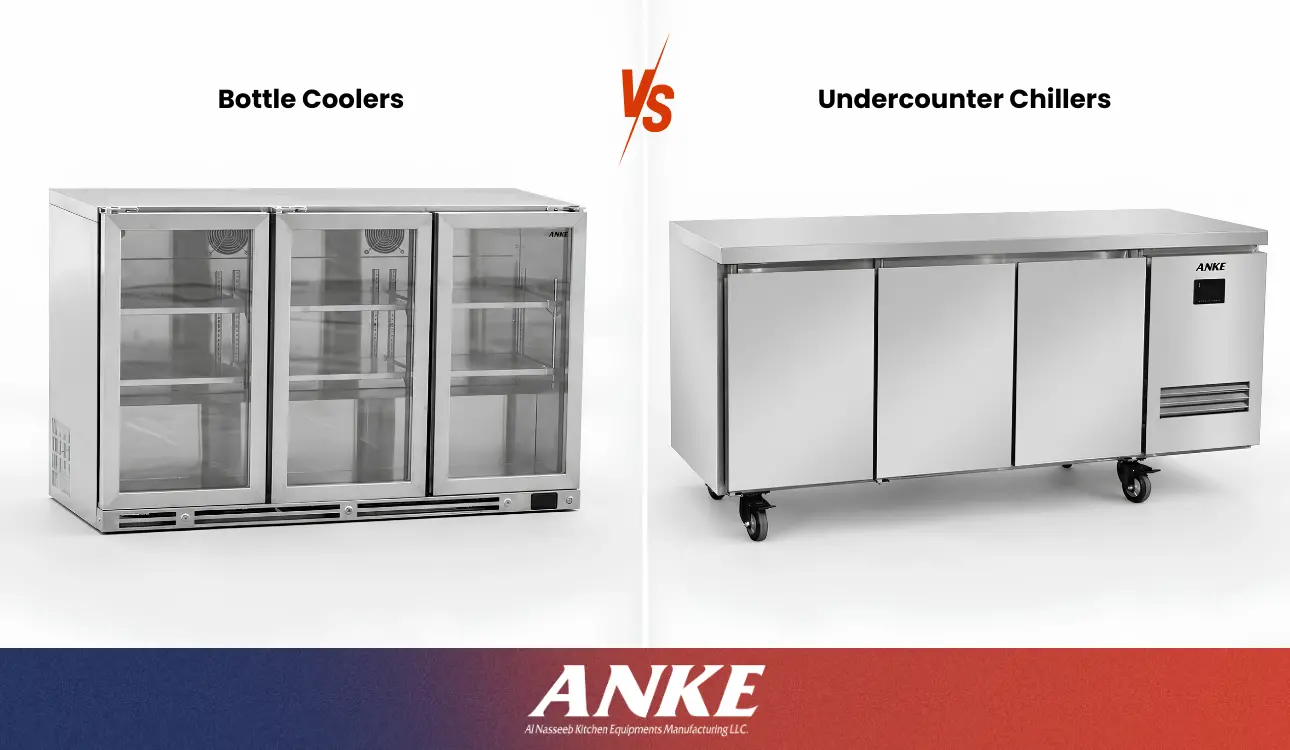
Choose a bottle cooler if guests need to see the product. Choose an undercounter chiller if staff need a work surface and gastronorm storage. In practice, though, the decision is usually settled by one figure neither supplier volunteers: depth. A bottle cooler is 520mm deep. An undercounter chiller is 700mm deep. Behind a bar counter, that 180mm decides more layouts than anything else on the spec sheet.
Both units are 850mm high. Both come in one, two, and three door widths. Both run on R290 refrigerant and both are rated for 43C ambient. On paper they look close to interchangeable, which is exactly why bars order the wrong one and find out on installation day.
At ANKE, we manufacture both, so this guide compares them honestly: what each one is actually built to do, the figures that separate them, and which belongs behind a bar counter as opposed to in a cafe service line. Both sit within the wider commercial refrigeration range.
What Is the Difference Between a Bottle Cooler and an Undercounter Chiller?
A bottle cooler is a merchandising unit. An undercounter chiller is a storage and prep unit. Every other difference follows from those two jobs.
A bottle cooler exists to sell what is inside it. It holds bottled drinks at 0C to +8C behind heated glass doors, with a mirrored 304 stainless interior and 6500K LED lighting so a guest can read a label from across the room.
An undercounter chiller exists to hold working stock and give staff a surface to work on. It holds -2C to +10C behind solid doors, under a removable 304 stainless worktop, with GN 1/1 shelving so prepped product transfers straight from the prep bench without being decanted.
- Doors: heated glass against solid insulated
- Interior: mirrored and LED lit against plain and air ducted
- Shelving: adjustable perforated stainless for bottles against GN 1/1 nylon coated on anti-tilt slides
- Top surface: not a work surface against a removable, customisable worktop
- Security: door locks fitted as standard against locks available as an option
Pro Tip: If the unit will face a guest, shelving type matters more than litres. Perforated shelves let cold air move between bottles standing upright. GN shelves are designed for containers, not for airflow around cylinders.
Bottle Cooler vs Undercounter Chiller: The Full Comparison
Every figure below is taken from the published ANKE specification for both units, so it is a like for like comparison rather than an industry average.
| Bottle Cooler | Undercounter Chiller | |
|---|---|---|
| Holding temperature | 0C to +8C | -2C to +10C |
| Depth | 520mm | 700mm |
| Height | 850mm | 850mm |
| Widths available | 600, 900, 1350mm | 900, 1350, 1800mm |
| Usable volume | 120 to 295 L | 86.1 to 253.5 L |
| Doors | Heated glass, solid optional | Solid |
| Shelving | Perforated 304G stainless | GN 1/1 nylon coated |
| Lighting | 6500K LED, mirrored interior | None |
| Worktop | Not a work surface | Removable 304 stainless |
| Refrigeration watts | 603 W | 350 W |
| Noise output | 58 to 68 dBA | 62 dBA |
| Annual energy | 558.5 to 664.3 kWh | 599.3 to 799 kWh |
| Energy class | E | B |
| Door locks | Fitted as standard | Available as an option |
| Refrigerant | R290 | R290, GWP 3 |
| Ambient rating | 43C | 43C |
Why Depth Decides More Bar Layouts Than Width Does
Most buyers compare width, because that is what the model list puts in front of them. Behind a bar, depth is the harder constraint and the one that forces redesigns.
A bottle cooler is 520mm deep. An undercounter chiller is 700mm deep. That 180mm is roughly the room a bartender needs to turn in a service aisle.
Depth also changes how much you get for the space, in a way that looks wrong until you understand it. Compare two cabinets of the same 1350mm width:
- Three door bottle cooler, 520mm deep: 295 litres
- Two door undercounter chiller, 700mm deep: 169.8 litres
The shallower cabinet holds considerably more. The undercounter is spending that volume on two things a bottle cooler does not have: a load bearing worktop across the top, and a compressor bay that has to stay reachable from the front so the unit remains serviceable once it is built into a counter run. Give up the worktop and you get the litres back.
Pro Tip: Measure the depth of your back bar run before you look at any model list. If you have under 600mm to work with, the decision has already been made for you.
Why Is One Rated Class E and the Other Class B?
Because a heated glass door is refrigeration and heating running at the same time, on purpose.
A bottle cooler holds 0C to +8C inside. On the other side of that glass, a UAE bar can sit at 24C with humidity pushed up by door traffic, guests, and the kitchen. Whenever the outer pane falls below the dew point of the room air, water condenses on it and the guest can no longer see the product. Heated glass doors hold that outer pane just above the dew point.
That costs energy, and the ratings show it:
- Two door bottle cooler, 190 litres: 664.3 kWh per year, Energy Class E
- Two door undercounter chiller, 169.8 litres: 602.5 kWh per year, Energy Class B
Similar volume, reasonably similar annual consumption, and four efficiency classes apart. That gap is not poor engineering. It is the price of being able to see through the door in a humid room, and glass insulates far less well than an insulated panel no matter who builds the cabinet.
Pro Tip: If the unit is going somewhere no guest will ever look at it, order the solid door option on the bottle cooler or specify an undercounter chiller instead. Paying for heated glass in a hidden position is the most common avoidable running cost in a bar fit out.
Which One Fits a Bar?
A busy bar usually needs both, in different positions.
Front line, facing guests, the bottle cooler does the selling. Bottled beer, mixers, and soft drinks stay visible and lit at 0C to +8C. Door locks are fitted as standard, which matters wherever stock is counted at the end of a shift.
Behind the line, out of sight, the undercounter chiller does the work. Garnish, citrus, dairy, syrups, and prepped batches sit on GN 1/1 shelves under a worktop staff can actually use.
- 600mm bottle cooler: the smallest back bar footprint, 120 litres, and the quietest cabinet at 58 dBA
- 900mm bottle cooler: 190 litres for a mid volume bar
- 1350mm bottle cooler: 295 litres for high volume service
- Undercounter chiller with a drawer bank: any door position can be swapped for 2 or 3 drawers where staff need fast repeat access
Pro Tip: Noise matters more front of house than most specifications acknowledge. A single door bottle cooler runs at 58 dBA, the quietest cabinet in the ANKE range. In a quiet lounge, the difference is audible from the bar stool.
Which One Fits a Cafe?
For most cafes the undercounter chiller is the working unit and the bottle cooler is the selling unit.
A cafe runs on prepped product: milk, cream, cut fruit, sandwich fillings, pastry components. That is GN 1/1 territory, and it needs a surface above it. The undercounter chiller gives both, in widths from 900mm to 1800mm.
The bottle cooler earns its place at the point of sale, where a cold drink is an impulse purchase rather than a request. A guest who can see a chilled bottle buys it. A guest who has to ask for one usually does not.
- Undercounter chiller for prep, dairy, and back of counter storage
- Bottle cooler at the till for bottled water, juices, and soft drinks
- Both are front breathing, so both sit flush in a counter run with no clearance gap behind them
If the constraint is bench space rather than floor space, a table top saladette handles garnish and cold toppings at only 270mm high, leaving the undercounter free for bulk.
Pro Tip: A cafe with a single counter run often gets more from one 1800mm undercounter chiller than from two smaller cabinets. Fewer compressors, fewer condensers to clean, and one continuous worktop instead of a joint that collects debris.
What Both Units Share
Several things that other suppliers charge extra for are standard on both, and they are worth knowing before you compare quotes side by side.
- Front breathing and venting: both draw air in and exhaust it at the front, so neither needs a clearance gap behind it and both can sit flush in a counter run
- 43C ambient rating: both are engineered to hold their set point through a UAE summer rather than adjusted down from a milder European standard
- R290 refrigerant: a natural refrigerant. The undercounter chiller datasheet lists a global warming potential of 3; the bottle cooler datasheet lists R290 without printing the GWP figure.
- 304 grade stainless steel: interior and exterior on both units
- Anti-condensation door frame heaters: fitted to both
- Waste heat recovery condensate vaporiser: evaporates condensate using waste heat, so no floor drain is needed under either unit
Pro Tip: Front breathing is the detail most layout drawings get wrong. If a designer has left a service gap behind your back bar purely for airflow, you can reclaim that floor area.
Common Mistakes When Choosing Between the Two
These come up repeatedly in bar and cafe fit outs across Dubai, Sharjah, and Ajman, and every one is avoidable at the specification stage.
- Comparing width and ignoring depth. 520mm against 700mm is the constraint that most often forces a redesign at installation.
- Buying glass doors for a hidden position. Heated glass exists so guests can see in. Behind a solid bar front it is a running cost with no return.
- Assuming litres scale with footprint. A 1350mm bottle cooler holds 295 litres. A 1350mm undercounter chiller holds 169.8. Same width, very different capacity, because one carries a worktop and a front serviceable compressor bay.
- Overlooking door locks. They are fitted as standard on the bottle cooler and are an option on the undercounter chiller. On a bar holding countable stock, that belongs on the quote.
- Packing perforated shelves solid. Perforated shelves only work if air can move between the bottles. A shelf packed edge to edge leaves the back row warm.
- Planning a clearance gap that is not needed. Both units are front breathing. The gap behind them is wasted floor area.
Choose the Right Unit for Your Space with ANKE
The decision comes down to three questions. Does a guest need to see the product? Do staff need a surface to work on? And how much depth do you actually have to give it?
ANKE has manufactured commercial refrigeration in the UAE since 1997, building both units in 304 grade stainless steel from our facility at 105 Amr Ibn El Aas Street, Ajman Industrial 1. Both come in three widths, and custom sizes are built to order where a standard configuration does not fit the run.
Whether you are fitting out a new bar, refreshing a cafe counter, or replacing a unit that never fit properly in the first place, contact us today for a free consultation and we will confirm which cabinet suits your space.
Frequently Asked Questions
Can a bottle cooler replace an undercounter chiller?
Not for prep work. A bottle cooler has no usable worktop and uses perforated shelves sized for bottles rather than GN 1/1 containers. It can hold packaged product, but it cannot serve as a work surface.
Can an undercounter chiller have glass doors?
The ANKE undercounter chiller is a solid door unit. Where glass is needed, the bottle cooler is the cabinet built for it, with heated glass and anti-condensation door frame heaters.
Which one is more energy efficient?
The undercounter chiller on class, rated B against the bottle cooler’s E. In absolute terms the annual figures are closer than the classes suggest: 602.5 kWh for a two door chiller against 664.3 kWh for a two door bottle cooler.
Which one is quieter?
A single door bottle cooler at 58 dBA is the quietest, rising to 68 dBA on the three door version. The undercounter chiller runs at 62 dBA across all three widths.
Do either of them need space behind for ventilation?
No. Both are front breathing and venting, drawing air in and exhausting it at the front grill, so both can sit flush against a wall or inside a continuous counter run.
What temperature does each one hold?
The bottle cooler holds 0C to +8C. The undercounter chiller holds -2C to +10C.
Can I have drawers instead of doors?
On the undercounter chiller, yes. Any door position can be replaced with a bank of 2 or 3 drawers. The bottle cooler is a door only unit.
Are both rated for UAE heat?
Yes. Both carry a 43C ambient rating, so both are built to hold temperature through a UAE summer.
