
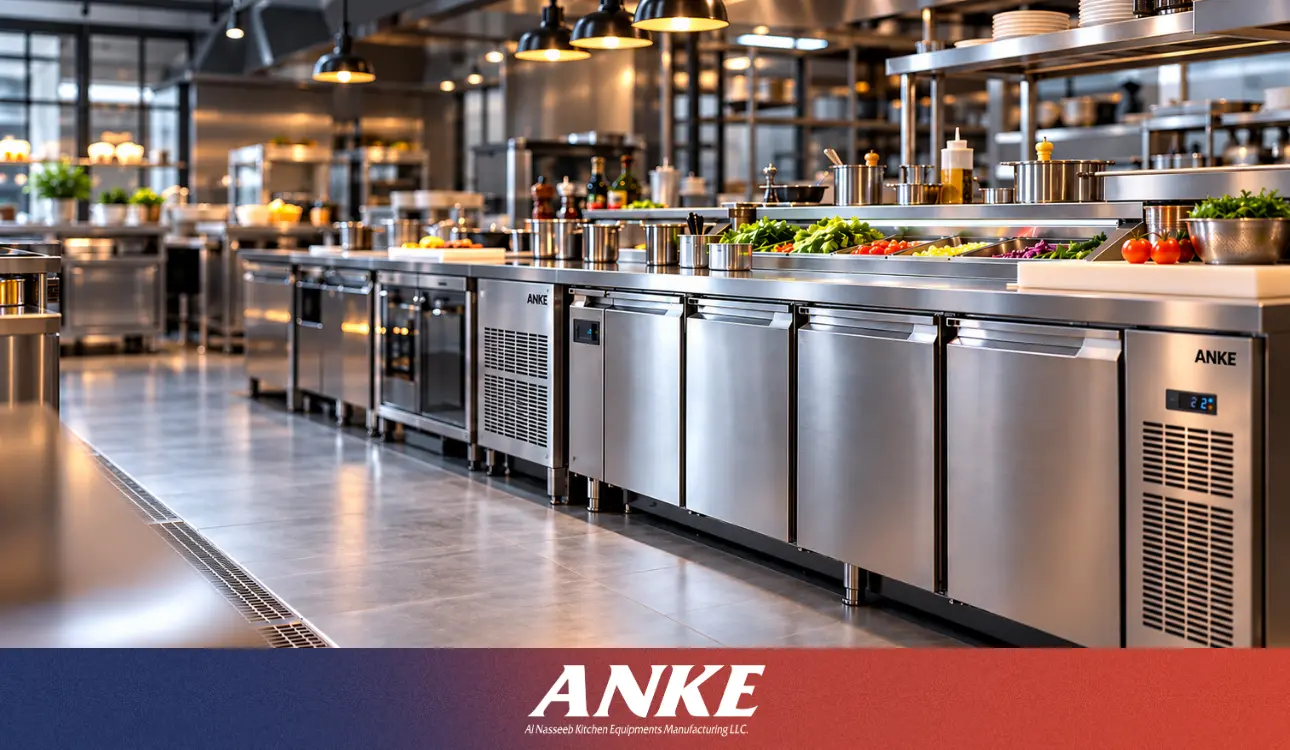
There is no single right amount of refrigeration for a restaurant. The answer depends on your menu, your top-selling dishes, how much stock you hold and how often you receive deliveries. As a general planning estimate, a full-service restaurant starts at about 28 to 42 litres of usable refrigerated space per seat, so a 60-seat restaurant starts at roughly 1,700 to 2,500 litres. Use that figure only as a first check, then plan from your menu, station by station.
Why is there no single answer?
Two restaurants with the same number of seats can need very different refrigeration. A seafood grill keeps fresh fish, ice and marinated meat cold all day. A pizza and pasta restaurant keeps cheese, dough and sauces chilled but holds little frozen stock. A dessert cafe needs chilled storage and display space for cakes and cream.
As the ANKE team puts it: “There is no one answer. It depends on what the menu is, what the restaurant sells most and what it needs day to day.” This is why ANKE plans refrigeration for each restaurant separately. The seat-based estimate in the next section helps you check whether a plan sits in a sensible range.
What is a reasonable starting estimate?
Food service designer Ken Feustel suggests about 1 to 1.5 usable cubic feet of refrigeration per seat for a three-meal restaurant, writing in Restaurant Business. One cubic foot is about 28.3 litres, so this equals about 28 to 42 litres per seat.
| Seats | Starting estimate (usable litres) | Typical starting set |
| 30 | 850 to 1,250 L | 1 single-door upright chiller, 1 single-door upright freezer, 2 under counter chillers |
| 60 | 1,700 to 2,500 L | 1 double-door upright chiller, 1 single-door upright freezer, 3 to 4 under counter units |
| 100 | 2,800 to 4,200 L | 2 double-door upright chillers, 1 double-door upright freezer, line units, or a cold room |
| 150+ | 4,200 L and above | A cold room plus reach-in and under counter units at each station |
These figures are general planning estimates, not requirements. Your menu, deliveries and peak days move the number up or down.
How do you plan refrigeration from your menu?
Start with what you sell most, not with the seat count:
- List your 10 to 15 top-selling dishes and the portions you sell on a busy day.
- Write down the chilled and frozen ingredients each dish needs, and the amount per portion.
- Mark each ingredient as chilled (at or below 5°C) or frozen (-18°C or colder).
- Multiply by the days of stock you hold between deliveries.
- Note which ingredients must be kept apart: raw meat, seafood, dairy and ready-to-eat food.
How does menu style change the chiller and freezer mix?
| Menu style | Needs more | Needs less |
| Scratch kitchen (fresh meat, dairy, produce) | Chilled space, more line units | Freezer space |
| Heat-and-serve or frozen-led menu | Freezer space | Chilled prep space |
| Seafood and grill | Chilled space near 0°C, separate raw storage | Dry storage |
| Cafe and bakery | Chilled display and cream storage | Large freezers |
| Delivery-heavy menu | Under counter units near the pass | Back store space per seat |
What else changes the number?
- Delivery frequency: fewer deliveries mean more days of stock on the shelf. Use your real supplier schedule, not a guess.
- Food separation: raw and ready-to-eat food need separate shelves or units, which takes more space than volume alone suggests.
- Delivery and catering orders: app orders and outside events add volume that the seat count does not show.
Which peak days should UAE restaurants plan for?
Size for your busiest day, not your average day. In the UAE that usually means Ramadan iftar and suhoor service, weekend brunch, Eid, New Year and event nights, and delivery app promotions that double orders for a day.
How do you turn your menu plan into units?
- Add up the chilled litres and the frozen litres separately.
- Compare the total with the starting estimate (seats x 28 to 42 litres). If you are far outside that range, recheck your menu figures.
- Leave space for air. Cold air must move around food, so never plan to fill units to the top.
- Split the volume by station: back store or line, chilled or frozen.
- Choose units by their net usable litres on the spec sheet, not by their outside size.
Which station needs which refrigeration unit?
Restaurant refrigeration works as a set: a large store at the back and smaller units where staff work. The table lists the unit that usually fits each station and its usable volume in the ANKE range.
| Station | Unit that fits | Why | ANKE usable volume |
| Back store (dairy, prepped items, sauces) | Upright chiller | Bulk storage on GN 2/1 shelves | 450 L (1 door) or 1,017 L (2 doors) |
| Frozen stock | Upright freezer or under counter freezer | Holds -18°C to -22°C | 450 or 1,017 L upright; 86 to 254 L under counter |
| Cooking line (grill, fryer) | Under counter chiller | Mise en place within reach, worktop above | 86 L (1 door), 170 L (2 doors), 254 L (3 doors) |
| Pizza and sandwich prep | Preparation chiller | GN pans on top, storage below | 248 L or 371 L |
| Salad and topping line | Tabletop saladette | GN 1/3 trays on the counter | 45 L or 65 L |
| Bar and coffee | Bottle cooler and under counter chiller | Drinks and milk at the counter | 120, 190 or 295 L (bottle cooler) |
| Cook-chill or batch prep | Blast freezer | Brings cooked food down fast before storage | 20 or 40 kg per cycle |
Should you choose under counter or upright units?
- Upright units give the most litres per square metre of floor, so they suit the back store.
- Under counter units hold less but save steps and add a worktop, so they suit the line.
- In small mall kitchens, front-breathing under counter units can sit flush against walls and joinery.
Our comparison of upright vs undercounter refrigerators covers this choice in more depth.
How should you split chiller and freezer space?
Most restaurants need more chilled space than frozen space, but the menu decides the split.
- Freezers cost more to run. On ANKE’s spec sheet, a single-door upright freezer uses 5.81 kWh per 24 hours, while the matching chiller uses 1.92 kWh, about a third.
- Frozen stock moves more slowly. Buy freezer space for what your menu really keeps frozen, not “just in case”.
Example: Refrigeration Plan for a 60-Seat Dubai Cafe
Hypothetical example. An all-day cafe in Dubai has 60 seats, a scratch kitchen, fresh deliveries most days and frozen deliveries twice a week. Its top sellers are breakfast plates, sandwiches, salads and coffee, so it needs more chilled prep space than freezer space.
| Station | Unit | Usable volume |
| Back store | Double-door upright chiller | 1,017 L |
| Frozen stock | Single-door upright freezer | 450 L |
| Grill and hot line | 2-door under counter chiller | 170 L |
| Sandwich and cold prep | Preparation chiller | 248 L |
| Coffee bar (milk) | 2-door under counter chiller | 170 L |
| Drinks | Bottle cooler, 4 shelves | 190 L |
| Total | About 2,245 L |
The plan lands inside the 1,700 to 2,500 L starting range. A cafe with a frozen-led menu, or a seafood grill with the same seats, would split the same total very differently.
How do Dubai heat and Dubai Municipality rules affect the plan?
- Ambient rating: a unit only holds temperature in the room heat it was built for. ANKE upright, under counter and bottle cooler units are rated for 43°C ambient; preparation chillers and saladettes for 32°C. Our guide to chiller vs fridge vs freezer explains the difference.
- Temperatures: the Dubai Food Code keeps high-risk food at or below 5°C and frozen food at -18°C or colder (section 3.2.3.1).
- Separation: raw and ready-to-eat foods are kept apart, and ready-to-eat food is never stored below raw food (sections 3.2.5 and 3.4.1).
What are the signs of too little or too much refrigeration?
| Too little | Too much |
| Shelves packed with no space for air | Units half empty most days |
| Temperature rises above 5°C at peak | High electricity use for little stock |
| Staff walk to the back store for line items | Old stock forgotten at the back |
| Raw food stored above ready-to-eat food | Floor space lost that the kitchen needs |
What should you send a manufacturer for a quote?
- Your menu and your top-selling dishes
- Number of seats and expected peak covers per day
- Delivery schedule for fresh and frozen stock
- Kitchen layout or drawing with each station marked
- Room temperature near each station, if known
- Power points available and voltage
- Opening date and any planned growth (delivery, catering)
Frequently asked questions
How many fridges does a small restaurant need?
Most small restaurants start with 3 to 5 units: one upright chiller and one freezer at the back, and under counter units at each station. A menu with more fresh or frozen stock may need more.
Do I need a cold room or reach-in units?
It depends on volume. Small and mid-size restaurants usually manage with reach-in and under counter units. Large restaurants (often 150 seats and above) and central kitchens may need a cold room.
Can I add refrigeration later as the restaurant grows?
Yes, if you plan for it. Leave floor space and a spare power point near the line for one more under counter unit, especially if you expect delivery orders to grow.
Planning Restaurant Refrigeration: Key Points
Refrigeration capacity is decided by your menu, stock levels and deliveries; litres per seat only checks that the plan is in a sensible range. As a next step, list your top-selling dishes and their ingredients, then map them to stations. Keep in mind that the figures in this guide are planning estimates; the final capacity should be calculated for your restaurant’s specific menu and layout.
Planning Refrigeration for a New Restaurant in Dubai? Talk to ANKE
ANKE International has manufactured commercial kitchen equipment in Ajman since 1997. ANKE upright and under counter chillers and freezers use 304 stainless steel and R290 refrigerant, are built to run in 43°C ambient, and carry a 1-year warranty.
- See the full commercial refrigeration range.
Send us your menu, seats and layout, and we will calculate the refrigeration for your restaurant station by station, with usable litres for every unit. Contact us or WhatsApp the ANKE team to discuss your project.
