
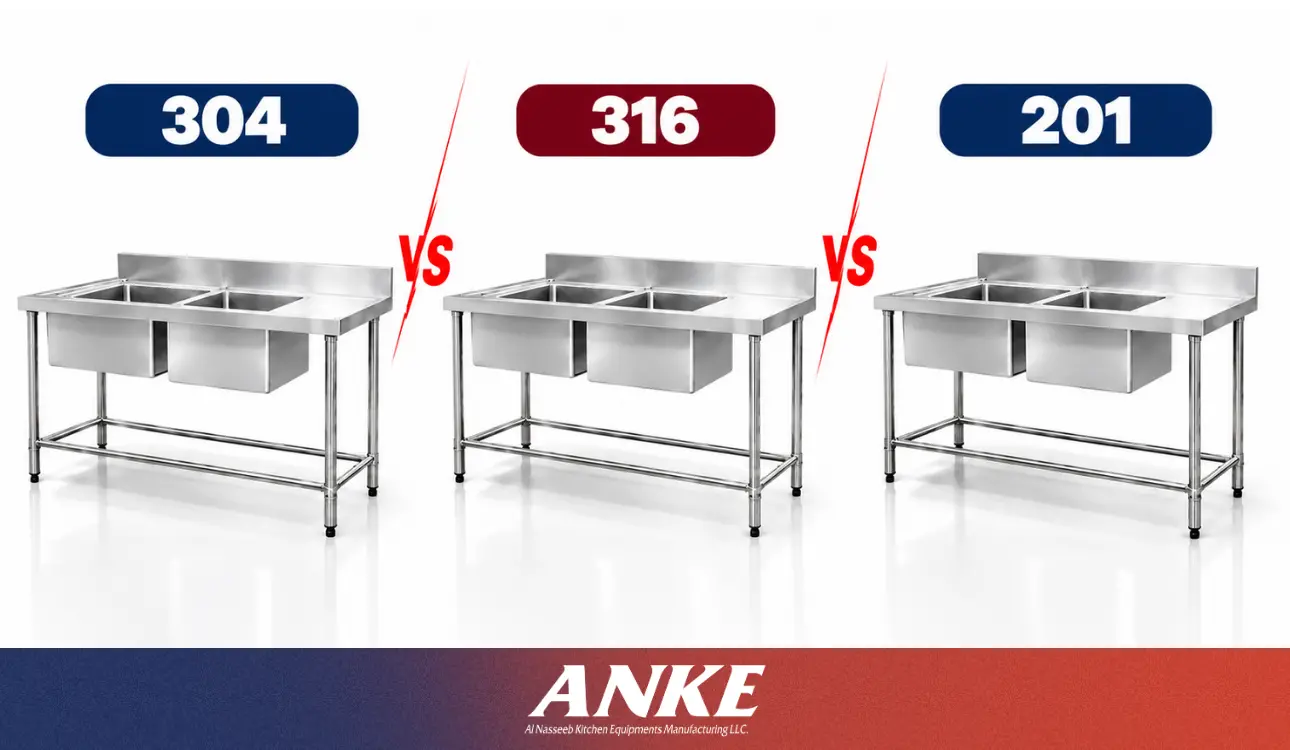
For a UAE commercial kitchen, use grade 304 stainless steel on every part that touches food, water or cleaning chemicals. Choose grade 316 where salt, brine, sea air or strong chlorine are present all day. Keep grade 201 out of sinks and wet areas, because it has less nickel and pits faster in humid, salty conditions. All three look the same when new, so the grade must be written on the quote and checked on delivery.
What is the difference between 304, 316 and 201 stainless steel?
Grades 304, 316 and 201 are all austenitic stainless steels. They differ in nickel, manganese and molybdenum, and that mix decides how well each grade resists rust and what it costs.
| Property | 304 (EN 1.4301) | 316 (EN 1.4401) | 201 (EN 1.4372) |
| Chromium | About 18% | 16% to 18% | 16% to 18% |
| Nickel | About 8% | 10% to 14% | 3.5% to 5.5% |
| Molybdenum | None | 2% to 3% | None |
| Manganese | Up to 2% | Up to 2% | 5.5% to 7.5% |
| Resistance to salt and chlorine | Good | Highest of the three | Lowest of the three |
| Relative cost | Medium | Highest | Lowest |
Read the table from left to right as a trade-off. Nickel and molybdenum are the expensive elements, so 316 costs the most and 201 the least. The saving on 201 comes directly out of corrosion resistance.
What do the grade numbers mean?
- 200 series: chromium, nickel and manganese (example: 201).
- 300 series: chromium and nickel, the main food equipment family (304, 316). “18/8” describes 304: 18% chromium, 8% nickel.
- “L” versions (304L, 316L) have less carbon, which helps welded joints resist corrosion.
What does Dubai Municipality ask for in kitchen stainless steel?
Dubai Municipality does not name one grade for every part. It asks for equipment that stays smooth and undamaged by food and cleaning chemicals:
- The Dubai Food Code, section 2.9.1, asks for materials “resistant to denting, pitting, chipping and cracking” and “not affected by foods, cleaning compounds”.
- The Technical Guidelines for Food Contact Materials (DM-HSD-GU132-FCM2), section 6, note that manganese in 200 series steel “results in weaker corrosion resistance”.
Inspectors do not test the alloy. They see the result: a pitted sink bowl or rust under a drainboard. The grade decides how soon that happens.
Why does 201 rust in UAE kitchens when 304 and 316 do not?
Chromium forms a thin oxide film on the surface that stops rust. Chloride breaks this film. Nickel helps the film heal, and molybdenum in 316 makes it harder to break in the first place. Grade 201 has about half the nickel of 304 and no molybdenum, so it pits first.
Where does chloride come from in a UAE kitchen?
- Salt and brine from marinating and seafood prep.
- Chlorine cleaners used for daily sanitising.
- Humid coastal air in Dubai, Sharjah, Ajman and Abu Dhabi.
- Standing water in sink corners, at weld seams, under drainboards and around leg feet.
Is 201 ever the right choice?
Grade 201 can work on dry, indoor, low-risk parts where price matters most, such as shelving in an air-conditioned dry store. It is not suitable where parts are wet, salted or cleaned with chlorine.
When is 316 stainless steel worth paying for?
Pay for 316 where chloride is heavy every day. For most indoor kitchens, 304 is enough.
UAE kitchens where 316 pays off
- Seafood restaurants and fish counters, where brine, ice and salt sit on the surface all shift.
- Beach clubs, hotel pool bars and villa terraces near the sea, where salty, humid air reaches the steel day and night.
- Pickling, brining and marinating stations, including shawarma and grill marinades.
- Areas cleaned with strong chlorine several times a day, such as central kitchens.
When is 304 enough?
For an indoor restaurant, hotel or cafe kitchen with normal cleaning, 304 is the usual specification. ANKE builds in 304 as standard, and 316 is available on request for extra corrosion resistance.
Which grade belongs on which part of the kitchen?
One table or sink unit is made of several parts, and a quote can mix grades between them. The table below shows the grade each part needs in a standard indoor kitchen and in a seafood or sea-front kitchen.
| Part | Indoor kitchen</spanb | Seafood or sea-front kitchen | Why |
| Sink bowls and drainboards | 304 | 316 | Water, salt and chemicals all day |
| Prep table tops | 304 | 316 for fish and brine prep | Food contact plus daily sanitising |
| Splashbacks | 304 | 304 or 316 | Splashes, steam and frequent cleaning |
| Legs and feet on wet floors | 304 | 316 outdoors | Water pools at the base |
| Undershelves in wet areas | 304 | 304 or 316 | Edges trap water |
| Dry-store shelving | 304 (201 only if kept dry) | 304 | No water, no direct food contact |
| Screws and fixings | Same as the part | Same as the part | A lower-grade screw rusts and stains the steel around it |
You can see this part-by-part approach on an ANKE double bowl sink table with drainboard or a stainless steel work table.
Which surface finish should kitchen steel have?
- No.4 (brushed): the usual kitchen finish; it hides fine scratches.
- 2B (mill): smooth and slightly reflective; used for hidden or structural parts.
- Welds on food-contact areas should be ground smooth, because rough welds trap food in any grade.
How thick should commercial kitchen stainless steel be?
Thickness and grade are separate choices: a thin 316 top still dents. Imported quotes often use gauge, where a lower number means thicker steel.
| Gauge | Approx. thickness | Typical kitchen use |
| 14 | About 2.0 mm | Tops carrying heavy equipment |
| 16 | About 1.6 mm | Heavy-use work tables and sink tops |
| 18 | About 1.2 mm | General work tables and shelves |
| 20 | About 0.9 mm | Light panels and cladding |
Ask for the thickness of each part and how the top is reinforced underneath. ANKE thickness per part:
How can you check which grade you are buying?
New 304, 316 and 201 look identical, so check the paperwork first and then measure:
- Grade per part on the quote, ideally with the European number (1.4301 for 304, 1.4401 for 316).
- Thickness per part in millimetres.
- Mill test certificate (EN 10204 type 3.1) for the sheet used. It proves the sheet, not that the sheet went into your table.
- Grade print on the protective film or sheet edge, checked before the film comes off.
- Handheld XRF reading on delivery. It reads chromium, nickel, manganese and molybdenum in seconds, and UAE inspection companies offer it.
- Molybdenum spot test, to tell 316 from 304. It cannot tell 304 from 201.
A magnet does not help here: none of the three grades pulls a magnet strongly.
Why do two quotes for the same table differ so much?
Two quotes for “a stainless steel sink table” can describe different products. The price gap usually hides in grade, thickness, undershelf and leg grade, reinforcement and weld finish.
Example: two quotes for a seafood restaurant sink table
Hypothetical example. A Dubai seafood restaurant compares two quotes for a 1,800 mm double bowl sink table. Quote A lists 316 bowls and drainboard, a 304 frame and the thickness of every part. Quote B says “stainless steel” throughout, with no grade and no thickness, and is cheaper. If Quote B is 201, the bowl corners can pit within the first humid summer. Replacing the table then means disconnecting plumbing and losing a prep shift.
Ask every supplier to fill the same three columns: part, grade, thickness. Compare price only after that.
How do you clean stainless steel so it lasts in a UAE kitchen?
- Rinse chlorine sanitiser off with clean water, then wipe dry.
- Wipe along the polish lines and dry sink bowls at closing time.
- Remove brown “tea staining” from coastal air with a stainless steel cleaner.
- Avoid steel wool; its iron particles rust and look like failing steel.
- Do not leave bleach, brine or acidic marinades on the surface overnight, even on 316.
Which grade should you choose?
- If the part touches food, water or chlorine cleaners indoors, choose 304.
- If the part handles salt, brine or sea air all day, choose 316.
- If the part stays dry and never touches open food, 201 is an acceptable saving.
- If a supplier quotes 201 for a wet or food-contact area, ask for a 304 price and compare it against the cost of early replacement.
What should you ask a stainless steel supplier before you sign?
- Which grade is each part: top, bowls, undershelf, legs, feet and fixings?
- What is the thickness of each part in millimetres?
- Can you share the mill test certificate (EN 10204 3.1)?
- Can we take an XRF reading on delivery?
- How is the top reinforced, and are welds ground smooth?
- What does the warranty cover and exclude?
Frequently asked questions
Is 201 stainless steel food safe?
Yes, for dry parts. Dubai Municipality lists the 200 series as a food contact material but notes its weaker corrosion resistance, so keep 201 away from sinks, wet prep and chlorine cleaning.
Why does my stainless steel sink have rust spots?
The usual causes are iron particles from steel wool or nearby grinding, chloride left behind by bleach, salt or brine, or a lower grade such as 201 in a wet area. Clean, rinse and dry the spot, then check the grade.
What about 430 stainless steel?
Grade 430 is a magnetic steel with almost no nickel. Dubai Municipality accepts 400 series steel for food contact only with 16% or more chromium. It suits dry panels, not sinks or wet worktops.
Choosing the Right Grade: Key Points
The grade decides how long kitchen steel stays smooth and rust-free in UAE conditions: 304 for most parts, 316 where salt and chlorine are heavy, and 201 only where parts stay dry. As a next step, ask every supplier for grade and thickness per part, and check one unit with XRF on delivery. Grade is only one factor: thickness, weld finish and daily cleaning also decide how long a table lasts, and the final specification should match your kitchen’s layout and menu.
Comparing Stainless Steel Quotes in Dubai? Ask ANKE First
ANKE International has manufactured commercial kitchen equipment in Ajman since 1997. ANKE builds its stainless steel kitchen equipment in 304 stainless steel, with 316 available on request for seafood and sea-front kitchens.
- The ANKE range of stainless steel flat pack furniture covers sink tables, work tables, shelves and cabinets that ship flat and assemble on site.
- ANKE works to ISO 9001 and HACCP, and every unit carries a 1-year warranty.
- Planning a full kitchen? See our guide to commercial kitchen setup in Dubai.
Send us your layout or equipment list, and we will state the grade and thickness of every part. Contact us or WhatsApp the ANKE team to discuss your project.
