
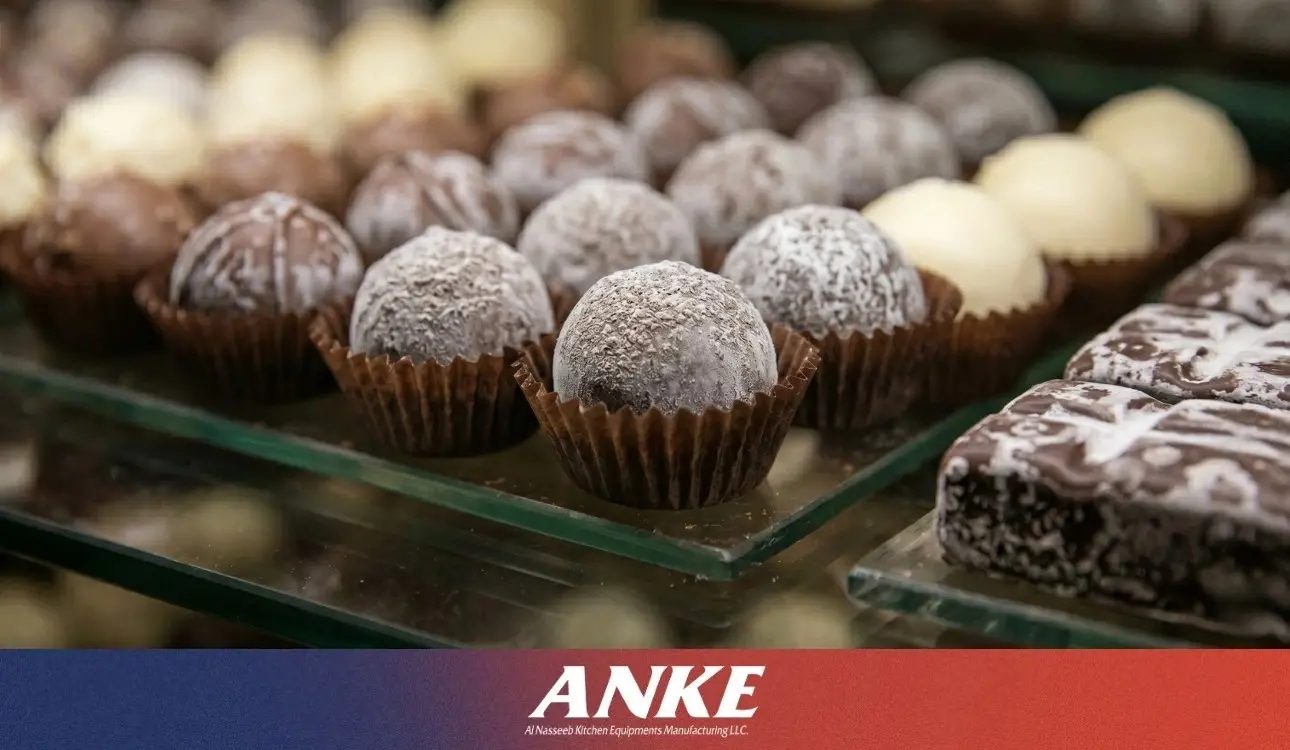
Chocolates turn white in a chocolate display cabinet because of bloom, either sugar bloom from humidity above 55 percent relative humidity or fat bloom from temperature cycling above 20 degrees Celsius. A dedicated ANKE chocolate display counter holds 12 to 18 degrees Celsius with humidity below 55 percent, the only combination that prevents both bloom types in Dubai.
A fresh batch of truffles arriving glossy on Monday can look dusty and unsellable by Wednesday. Most owners blame the supplier or the recipe. The real cause is almost always the equipment itself.
White coating on chocolate is not mold and not a food safety risk. The damage is commercial: customers associate white coating with expired product and walk past the display, turning premium inventory into a retail write-off within days.
ANKE International is a consultant-listed fabricator and one of the top three custom kitchen equipment fabricators in the UAE, fabricating commercial display equipment since 1997. Here is why chocolate blooms and how to stop it.
What Causes Chocolates to Turn White in a Display Cabinet?
Chocolate turns white because of bloom, a cosmetic change in which either moisture or cocoa butter migrates to the surface and re-crystallises. Bloom is cosmetic damage, not microbial spoilage, but in retail it equals lost revenue within hours of appearing.
Three commercial problems make bloom dangerous for your business:
- Customers cannot distinguish bloom from spoilage
- A single batch loss can wipe out a week of profit
- Bloom spreads visually across neighboring pieces
- Bloomed chocolate cannot be reversed on finished product
A bloomed batch must be discarded or re-melted for baking applications only. Re-selling bloomed stock at full retail price damages brand trust, and discounting it signals the chocolate is defective. Prevention through the correct chocolate display cabinet is the only economical strategy for Dubai chocolatiers.
Sugar Bloom vs Fat Bloom: The Two Culprits
Sugar bloom and fat bloom look similar at a glance but have completely different causes and fixes. Identifying which type is hitting your stock is the first step to stopping it.
| Feature | Sugar Bloom | Fat Bloom |
| Cause | Humidity above 55% RH causes
condensation on chocolate surface |
Temperature cycling between
20 and 30°C, not a fixed threshold |
| Look and feel | White dusty, grainy coating.
Feels sandy to touch. |
Grey or white streaks.
Feels slightly greasy. |
| Reversible? | No. Retail write-off only. | No on finished product.
Can be re-melted for baking. |
In Dubai, both bloom types often hit the same batch. Summer humidity triggers sugar bloom at the surface while afternoon indoor temperature spikes trigger fat bloom deeper in the chocolate.
A chocolate display counter built for Dubai’s climate must block both mechanisms at once, which is why dedicated equipment outperforms any general-purpose refrigerated case.
Why Dubai’s Climate Triggers Chocolate Bloom Fastest
Dubai’s ambient humidity averages 50 to 60 percent most of the year and often exceeds 80 percent in summer. Chocolate needs storage humidity below 55 percent, so your shop air is already in the danger zone before the display cabinet opens. Humidity problems also cause fogged display glass and visibility issues. Learn practical maintenance steps in our guide on tackling glass condensation in display units.
Dubai Conditions vs Chocolate Requirements
- Dubai summer humidity: 70 to 90 percent relative humidity
- Dubai summer temperature: 35 to 45 degrees Celsius
- Air-conditioned shop interior: 22 to 26°C, 50 to 60 percent RH
- Chocolate requirement: 12 to 18°C, below 55 percent RH
- Conclusion: standard AC cannot protect chocolate
Every time the chocolate display cabinet opens, humid shop air rushes in and triggers the condensation cycle that dissolves surface sugar. Standard refrigerators make this worse because they run at 0 to 4 degrees Celsius with humidity above 70 percent, causing thermal shock and sugar bloom on contact.
5 Steps to Stop Bloom in Your Chocolate Display
Apply these five steps in order. The first four cost nothing and can be done today. The fifth is the permanent fix.
1. Measure actual conditions. Place a digital hygrometer and probe thermometer inside the chocolate display cabinet for 24 hours. Log morning, midday, and evening readings. Anything above 55 percent humidity or 2 degrees Celsius variation confirms you have the problem and need to act. For a full daily, weekly and monthly routine, follow our chocolate display cabinet maintenance and lifespan guide.
2. Move the display away from heat sources. Keep the unit at least 1 metre from windows, ovens, coffee machines, and service doors. Radiant heat raises cabinet surface temperature even when the interior thermostat reads correct.
3. Limit door openings to under 10 seconds. Every opening pulls humid shop air inside. Train staff to batch-serve multiple orders per opening, retrieve product quickly, and close firmly each time to prevent the condensation cycle that triggers sugar bloom.
4. Never mix chocolate with other foods. Chocolate is hygroscopic and absorbs dairy, fruit, and spice odors within 2 to 4 hours. A dedicated chocolate display counter used for chocolate only is non-negotiable for premium retail.
5. Upgrade to a dedicated ANKE chocolate display cabinet. This is the permanent fix. An ANKE unit holds 12 to 18 degrees Celsius with humidity below 55 percent and carries a 1-year compressor warranty, built at the Ajman factory for Dubai’s climate.
ANKE used this approach for humidity-controlled chocolate display counters for a three-store UAE chocolatier, VOCCA Chocolatier in Dubai, Sharjah and Fujairah, holding +12°C to +18°C with a controlled humidity system.
What ANKE Does NOT Recommend
- Do not use a cake display chiller for chocolate. A cake chiller runs 2 to 5°C with 60 to 75 percent humidity, the exact conditions that cause sugar bloom.
- Do not store chocolate in a regular fridge wrapped in plastic. Thermal shock damages cocoa butter the moment you unwrap it in shop air.
- Do not place desktop dehumidifiers inside the display. Commercial humidity control requires engineered airflow, not standalone units.
ANKE Chocolate Display Counter Specifications
ANKE chocolate display counter is built specifically for Dubai’s climate and manufactured at the ANKE factory at 105 Amr Ibn El Aas St, Ajman Industrial 1, UAE.
ANKE Chocolate Display Specs
- Temperature: 12 to 18°C, digital thermostat accurate to 0.5°C
- Humidity: ventilated indirect cooling holds below 55 percent RH
- Glass: double-glazed argon-filled anti-condensation panels
- Interior: 304 grade stainless steel, 1.2mm wall thickness
- Lighting: 3000K warm white LED with CRI above 90
- Refrigerant: R290 eco-friendly, low global warming potential
Custom sizes are available for boutique chocolatiers and 5-star hotels across the UAE. See what size chocolate display cabinet you need, or how we build chocolate display cabinets for hotels.
ANKE offers a free design consultation where the team reviews your space, product range, and daily volume before recommending the right chocolate display counter configuration. Before selecting equipment, review our guide on choosing a refrigerated chocolate display to understand the correct temperature and humidity specifications for professional chocolate storage.
Protect Your Chocolate Investment with ANKE
Every bloomed batch of chocolate is profit thrown away, and in a premium retail environment, every bloomed shelf is a signal to customers that the brand is not in control of its product. Prevention costs a fraction of the losses bloom creates over a single summer in Dubai.
Book a free climate-control consultation with ANKE International. The ANKE team will measure the actual temperature and humidity in your current cabinet, identify which bloom type you are fighting, and recommend a display cabinet that keeps every piece of chocolate glossy and sellable in Dubai’s climate.
Frequently Asked Questions
Is chocolate with white bloom safe to eat?
Yes. Sugar bloom and fat bloom are cosmetic damage, not microbial spoilage, and the chocolate is safe to consume. However, bloomed chocolate has degraded texture and flavor and cannot be sold at retail price. For premium chocolatiers in Dubai, bloom always means writing off the affected stock.
Can chocolate bloom be reversed?
No. Bloom cannot be reversed on a finished chocolate product. Sugar bloom is permanent. Fat bloom can be partially corrected by re-melting and re-tempering, but the product can only be used in baking or melted applications, not re-sold as fine chocolate. ANKE chocolate display cabinets prevent the problem at source.
What humidity level causes chocolate bloom?
Sugar bloom begins forming when relative humidity inside the display cabinet rises above 55 percent. Professional chocolatiers maintain humidity below 50 percent for the most consistent results. ANKE chocolate display cabinets use ventilated indirect cooling to hold humidity below 55 percent even in Dubai’s summer.
Can I use a deli case or cake chiller for chocolates?
No. Deli cases run at 2 to 5 degrees Celsius with humidity 70 to 85 percent, and cake chillers run at 2 to 8 degrees Celsius with humidity 60 to 75 percent. Both ranges are far outside chocolate’s 12 to 18 degrees Celsius and below 55 percent humidity requirement. Using the wrong cabinet actively causes bloom. ANKE manufactures dedicated chocolate display cabinets for this exact reason.
What temperature causes fat bloom in chocolate?
Fat bloom is caused primarily by temperature cycling rather than a single threshold. Research shows bloom formation accelerates when chocolate temperature cycles between 20 and 30 degrees Celsius over multiple hours. Any display cabinet that cannot hold temperature steady within 2 degrees Celsius will eventually produce fat bloom.
How much does a chocolate display cabinet cost in Dubai?
It depends on size, cooling system, humidity control, glass type and finish, so ANKE prepares a project-specific quote rather than one fixed price. See our full breakdown of chocolate display cabinet cost in Dubai, including running costs. Every ANKE custom display carries a 1-year manufacturer warranty
Do filled chocolates with cream or ganache need different storage?
Yes. Filled chocolates with cream, ganache, or dairy components are classified as potentially hazardous foods under Dubai Municipality Food Code 2.0 and legally require storage at 5 degrees Celsius or colder. Pure chocolate is shelf-stable and needs 12 to 18 degrees Celsius. ANKE provides guidance on dual-zone or rotational display strategies for chocolatiers selling both categories.
Why do regular refrigerators make chocolate bloom worse?
Regular refrigerators operate at 0 to 4 degrees Celsius with humidity above 70 percent, a combination that causes thermal shock when chocolate moves to warm shop air and triggers instant sugar bloom from condensation. They also expose chocolate to dairy, fruit, and onion odors, which absorb into the cocoa butter within hours. ANKE chocolate display cabinets solve all three problems simultaneously.
