
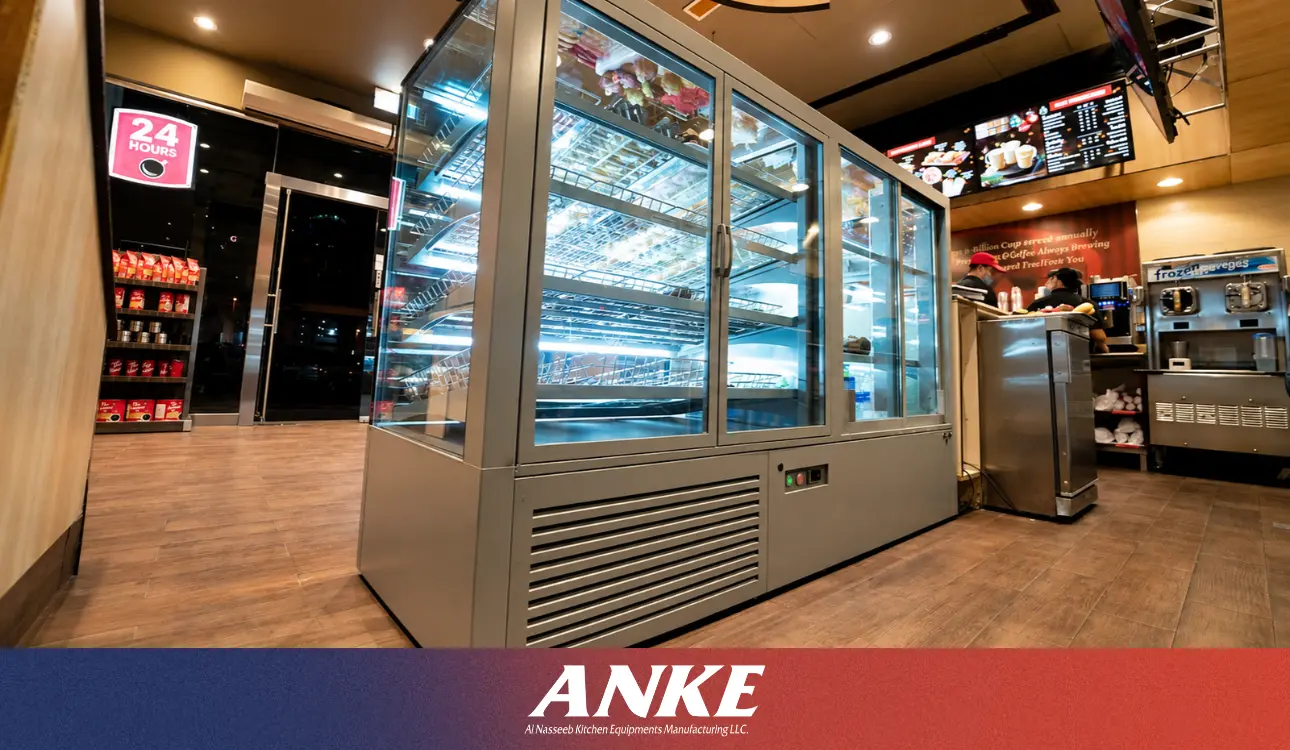
Choose plug-in for one or two counters, kiosks and fast installs in a commercial kitchen project. Choose remote for long counter runs, small enclosed shops, or when noise and air conditioning load matter. The difference is simple: a plug-in counter has its compressor inside the cabinet, so heat stays in your shop. A remote counter is piped to a condensing unit outside, so heat leaves the shop.
Decide at drawing stage, because changing later means new pipes, drains and approvals. This guide compares both systems for the refrigerated display counters in your commercial kitchen, including custom display counters built to your drawing.
Key takeaways
- Plug-in counters install fast and move easily, but add heat and noise to the shop.
- Remote counters keep the shop cooler and quieter, but need pipework and a place for the outdoor unit.
- In the UAE, the outdoor unit needs shade, free airflow and a rating for summer heat.
- Decide at drawing stage, not during fit-out.
What is the difference between remote and plug-in display refrigeration?
Plug-in (self-contained): the compressor, condenser and fans sit in the counter base. You place the counter, connect power and it starts cooling.
Remote (split): only the cooling coil stays in the counter. Copper pipes carry refrigerant to a condensing unit on the roof, outside or in a plant room.
Think of a window air conditioner versus a split one. Only the split keeps the hot, noisy part outside.
Where does the heat go, and why does it matter in the UAE?
A refrigerated counter does not make cold. It moves heat from the food to the condenser, which releases it into the air around it.
- Plug-in: the heat comes out at the counter base, inside your shop. Your air conditioning must remove it.
- Remote: the heat comes out at the condensing unit, away from customers.
In the UAE, a plug-in counter in a small kiosk can make the area near the display feel warm. A remote unit works in the open air, where summer afternoons can pass 45°C, so it needs shade and clear airflow.
Check the ambient rating of every unit. It is the hottest temperature the unit is designed to work in while holding its cabinet temperature, and it differs across product lines. Either way, the heat needs a clear path out: fresh air in, hot air out.
Remote vs plug-in: side-by-side comparison
| Factor | Plug-in (self-contained) | Remote (split) |
|---|---|---|
| Compressor | Inside the counter | Outside or in a plant room |
| Heat in the shop | Yes, at the counter | Almost none |
| Noise at the counter | Compressor and fans heard | Quiet at the counter |
| Installation | Place, level, plug in | Pipework, refrigerant charge, testing |
| Moving later | Easy | Hard; pipes must be rerouted |
| Upfront cost | Usually lower | Usually higher (pipes and installation) |
| Suits | Single counters, kiosks, short leases | Long runs, enclosed shops, new builds |
The verdict: if you need one or two counters fast, or may move, choose plug-in. If you have a long counter run, a small enclosed space, or strict noise and heat limits, choose remote.
Which one fits your commercial kitchen project?
Mall kiosk or small cafe: Plug-in is common because there is often no place for an outdoor unit. Plan ventilation gaps in the joinery. A grab and go display or a single pastry display usually starts here.
Bakery or cafe with several counters: Both work. If the counters line one long wall, remote keeps the customer area cooler. This suits a row of cake display and chocolate display counters.
Supermarket or long butchery run: Remote is the usual choice. Several cabinets can share one system, and service happens away from shoppers. See the meat display counters and the MLS Butchery case study.
Ice cream or frozen counters: They work hardest against the heat, so check the ambient rating first. See the ice cream display.
Quick decision check:
- Is there a shaded outdoor spot or plant room close to the counters?
- Will the counters stay in this position for years?
- Do you have a long counter run or a small enclosed shop?
Three yes answers usually point to remote. Any no is a reason to start with plug-in.
What should you settle at drawing stage?
- Pick the system for each counter: plug-in or remote.
- Mark the condensing unit spot for remote: shaded, with free airflow and service access.
- Plan the pipe route. Keep runs short, with few bends and rises, because long runs need more refrigerant and lose performance.
- Leave ventilation gaps for plug-in: keep front and rear grilles open in the joinery.
- Add power and a drain. Confirm sockets, electrical load and a condensate drain point.
- Get approvals. Check mall or landlord rules on outdoor units, noise and pipe routes.
- Test at the hottest hour. Check food temperature in the afternoon peak, not first thing in the morning.
What mistakes do the most damage?
- Boxing a plug-in counter inside closed joinery
- Placing the outdoor unit in direct sun with no airflow
- Leaving the pipe route to the last week of fit-out
- Forgetting the condensate drain
A real case from ANKE service visits: A counter installed with no path for hot air to leave failed within 3 to 4 days. The lesson ANKE shares on every project is to plan the ventilation path before the counter is built.
These mistakes lead to warm food, fogged glass or early compressor failure. If fogging is already a problem, read how to tackle glass condensation in display units. Writing the full equipment list? Use how to specify commercial chillers and freezers.
How ANKE helps you choose remote or plug-in
ANKE International has manufactured refrigerated display counters in Ajman since 1997. ANKE has built display counters for brands such as Tim Hortons, Bateel and VOCCA Chocolatier, and supplies the UAE, Saudi Arabia, Oman, Qatar, Bahrain and India.
Each counter is built to your approved drawing, so the condensing system is agreed before fabrication. Every unit carries a 1-year warranty. See how this works on a custom cake display counter, or browse all display counters.
Planning display counters for a UAE fit-out?
Send your floor plan and ANKE will recommend plug-in or remote for each counter, with the ventilation space marked.
Prefer WhatsApp? Message ANKE on +971 50 335 6748.
Frequently asked questions
Is a plug-in display counter louder than a remote one?
Usually, yes. A plug-in counter has its compressor and fans inside the cabinet. A remote counter moves that noise to the condensing unit.
Does remote display refrigeration save energy?
It can. Removing condenser heat from the shop lowers the load on the air conditioning, and several cabinets can share one system. The real saving depends on pipe length, outdoor unit placement and system design.
Can I change a plug-in counter to remote later?
Rarely in a practical way. A remote counter needs pipework, a condensing unit location and a drain planned into the building. It is far easier to decide at drawing stage.
Who installs a remote display system?
A qualified refrigeration technician connects the pipes, charges the refrigerant and tests the system. Ask whether this is in the quote.
