
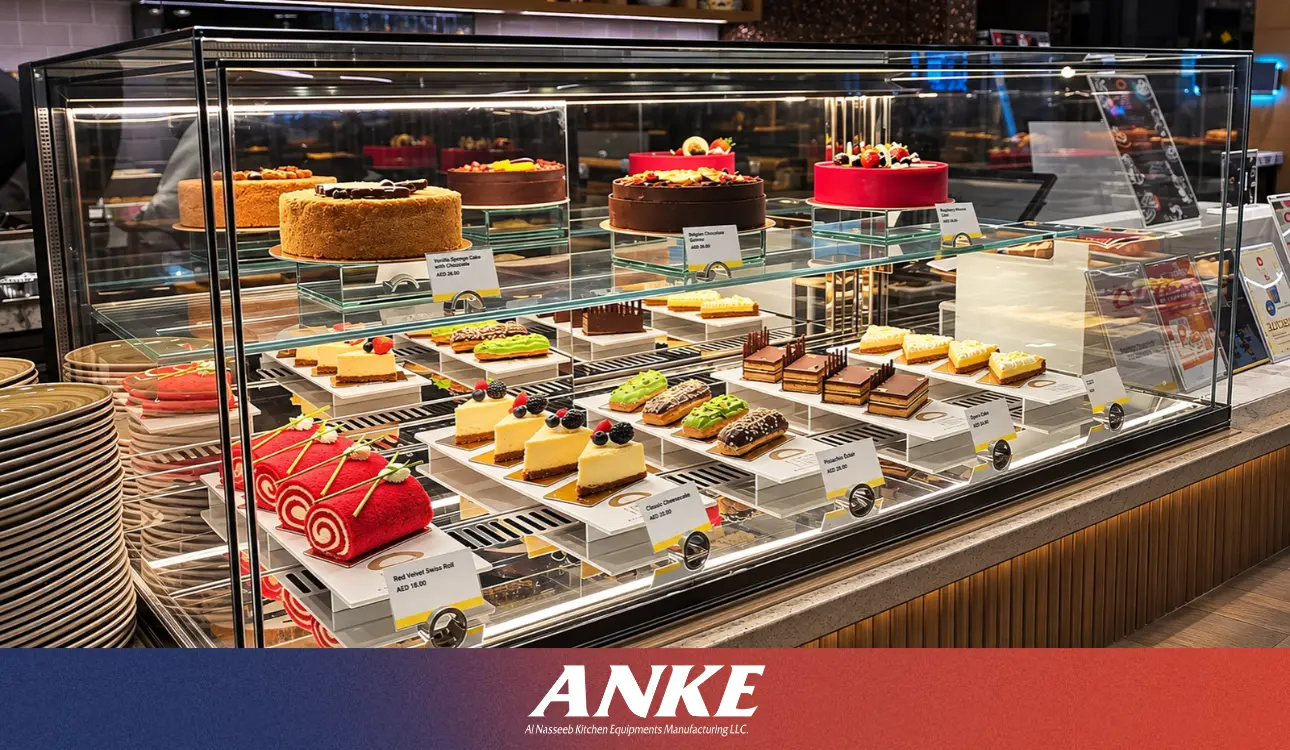
An inspector does not judge how good the counter looks. They check what the food is going through.
Dubai food inspectors check a display counter against the Dubai Food Code. They ask four questions: is the food cold or hot enough, protected, labelled when time is the control, and easy to keep clean? This guide explains the seven checks in plain words, gives the numbers, and ends with a daily routine, so the refrigerated display counters in your commercial kitchen are ready on any day.
The headline numbers: chilled high-risk food at or below 5°C, hot food at 60°C or above, frozen food at -18°C.
The mistake ANKE sees most: owners think cold air is enough. Ahmed Suhail of ANKE explains that Dubai Municipality probes the product core, for example the inside of a cake. That core, not the air, is what counts.
Key takeaways
- Inspectors probe the food core, not the dial.
- Cold food out of temperature control: 4 hours maximum.
- ANKE advises a product core of 2°C to 5°C, because the limit is 5°C.
- Rules change. Confirm the current edition with Dubai Municipality.
Which rules apply to display counters in Dubai?
The Food Code is Dubai Municipality’s rulebook for food businesses. For display, it covers temperature, time limits, contamination and clean equipment.
This guide quotes the 2013 edition, which sets chilled food at 5°C. Some current Dubai guides quote 4°C or below. Ask your inspector which edition applies, and aim lower for a margin. Clause numbers are in the table at the end.
What do inspectors check in a display counter?
Use this table as a self-inspection. It follows one cake from arrival to sale.
| Check | What the inspector looks for | Test it yourself | What helps in the counter |
| 1. Food temperature | Chilled high-risk food at or below 5°C | Push a probe into the core, as an inspector does. ANKE’s advice is a core of 2°C to 5°C | Even cold air, no overloaded shelves |
| 2. Thermometer | An accurate, reliable monitoring device, calibrated at set intervals | Compare the display with a probe | A clear digital display staff can read |
| 3. Loading and airflow | Staff know the loading limits and airflow | Look for food above the load line or covering the grilles | Marked load lines, open air grilles |
| 4. Protection | Food protected from public handling | Ask whether a customer can touch or breathe on it | Glass, packaging, sneeze guards on self-service sides |
| 5. Raw and ready-to-eat | The two kept apart at all times | Check that raw juices cannot reach ready-to-eat food | Separate zones or decks |
| 6. Cleanability | Smooth surfaces that can be cleaned and disinfected | Run a cloth along seals and corners | Smooth, rounded inner corners in 304 stainless steel |
| 7. Discard labels | A discard time on food held without temperature control | Read every label | Label space at the front of the shelf |
Why they matter: an overloaded top shelf warms first, and a bad thermometer hides a warm cabinet.
Fogged glass hides food from you and the inspector. Argon-filled insulated glass, used on the MLS units, helps hold temperature and resist condensation. An extended staff-side frame also keeps cold air on the steel, not the glass.
A real case from ANKE service visits: A counter installed with no path for hot air to leave failed within 3 to 4 days. The compressor needs fresh air in and hot air out, which is why ANKE agrees the ventilation space on the drawing.
The meat counters ANKE built for MLS Butchery were designed to hold 0°C to +4°C for fresh red meat during live store hours, even with frequent door opening. ANKE paired argon-filled insulated glass with managed airflow, because temperature alone does not stop the surface of meat drying out (see the MLS case study).
What are the temperature and time numbers?
Measure the food, not the air. These limits apply to high-risk food.
| What | Rule |
| Chilled food | At or below 5°C |
| Hot food | At least 60°C |
| Frozen food | -18°C |
| Cold food out of temperature control | Maximum 4 hours, then discard |
| Cooling cooked food | 60°C to 20°C within 2 hours, then to 5°C within 4 hours |
The cooling rule applies before food reaches the counter. A blast freezer helps kitchens meet it for batch-cooked food. To specify the back-of-house units, see how to specify commercial chillers and freezers.
Planning a counter for a Dubai outlet? Tell ANKE what you will display. Ask ANKE about your counter
What should staff check before opening?
- Read the display. Note the cabinet temperature.
- Probe one item. Choose the warmest-looking product, near the front.
- Check the load line. Move anything blocking the air grilles.
- Check labels. Every item out of temperature control needs a discard time.
- Wipe and look. Clean glass, seals and corners, and report damage.
- Probe again at the hottest hour. Busy service warms food.
Which display suits what you sell?
- Cakes: a cake display holds food at or below 5°C.
- Pastries and sandwiches: a pastry display or grab and go display suits fast service.
- Fresh meat: a meat display holds 0°C to +4°C. ANKE uses static cooling, with no fans. Think of a marathon runner against a sprinter: it cools gently and does not dry the meat.
- Frozen desserts: an ice cream display serves ice cream, while frozen food in storage is held at -18°C.
- Chocolate: a chocolate display is held warmer, so the 5°C rule is not its target.
Our view: a counter can pass the dial and fail the probe
A cabinet set to 3°C can still hold a cake at 7°C if it is overloaded or in a draught. Train staff to trust the probe, not the dial.
How ANKE helps you build inspection-ready counters
ANKE has built refrigerated display counters in Ajman since 1997 for cafes, bakeries, butcheries and hotels, including Tim Hortons, Bateel and MLS Butchery. Each counter is made to your drawing, in 304 stainless steel, with a 1-year warranty.
Browse all display counters or ask for a custom display counter. Next step: run the routine above tomorrow morning.
Want a display counter built around the Food Code?
Share what you will display and your layout. ANKE will recommend a counter.
Request a counter recommendation
Prefer WhatsApp? Message ANKE on +971 50 335 6748.
Frequently asked questions
What temperature must a display chiller hold in Dubai?
The 2013 Food Code asks for chilled high-risk food at or below 5°C, frozen food at -18°C and hot food at 60°C or above. Confirm the current edition with Dubai Municipality.
How long can cakes or sandwiches stay out of the chiller?
Cold high-risk food for immediate sale can stay between 5°C and 60°C for no more than 4 hours, including preparation. It must carry its discard time.
Are sneeze guards required on self-service counters?
Yes, in practice. Display food must be protected from handling. Self-service counters usually need a guard.
Where each rule sits in the Food Code
Clause numbers, 2013 edition:
| Check or rule | Clause |
| Chilled and frozen food temperature | 3.6.2 |
| Monitoring devices | 3.6.1 |
| Loading and airflow | 3.6.3 |
| Protection from public handling | 3.4.1 |
| Raw and ready-to-eat separation | 3.2.5 |
| Smooth, cleanable surfaces | 2.9.1 |
| Time as a control and discard labels | 3.3 |
| Hot food temperature | 3.2.10 |
| Cooling cooked food | 3.2.11 |
