
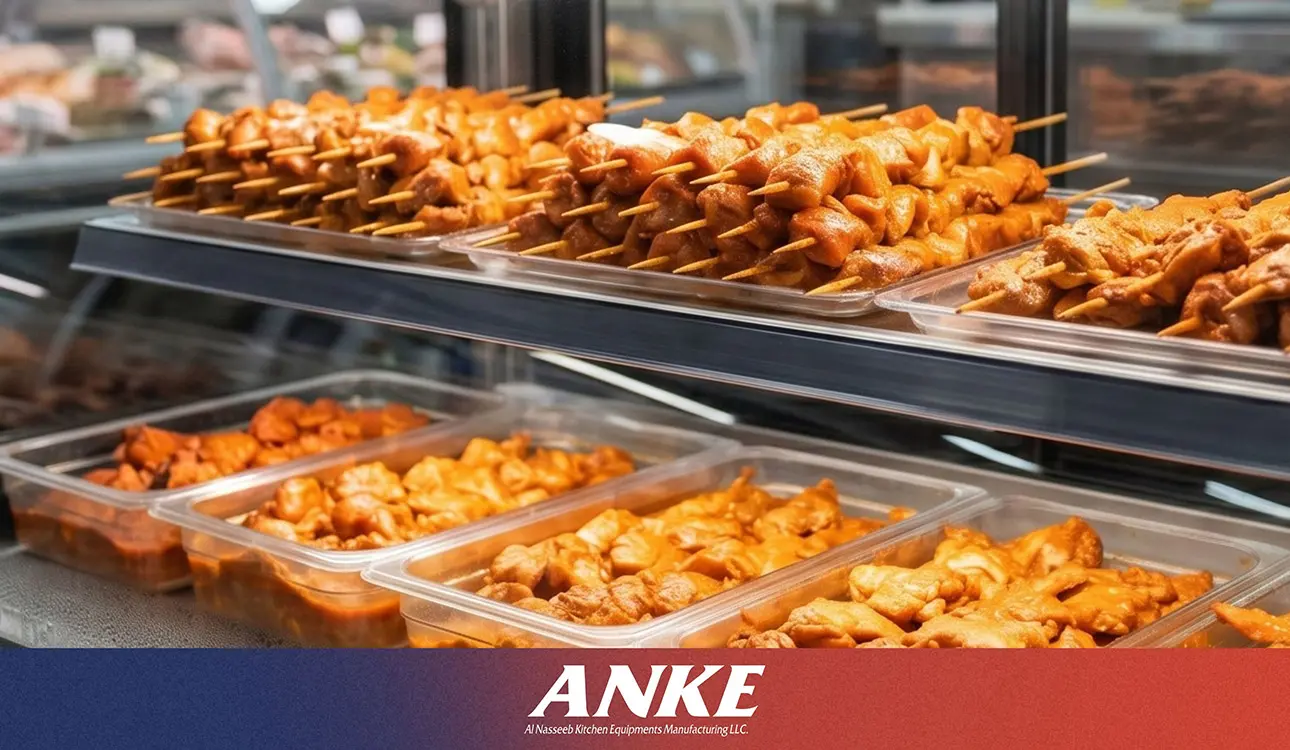
If your kebabs look dry and dull at the end of the day, the chiller is the likely cause, not the recipe. The problem is moving air, not temperature.
Meat carries between 50% and 70% of its body weight in water. When a fan runs inside a display chiller, it does not just cool the air. It evaporates moisture from whatever is exposed to it. For marinated meat, the masala coating sits on the surface. That is exactly where the airflow hits first.
At ANKE, we fabricate both static cooled and ventilated commercial meat display chillers for butcheries, supermarkets, and cloud kitchens in Dubai and the UAE. Visit our commercial meat displays page for the full range. This guide explains the engineering behind each cooling system and the decision rule that protects your product.
| Key Takeaways
• Fan airflow in a ventilated chiller: strips moisture from the masala surface layer. That is why marinated meat looks and tastes different at closing time. • Static cooling has no fans: the cooling coil is wound around the cabin walls. The marinade stays intact through the full trading day. • High-traffic fresh red meat: needs ventilated cooling with engineered airflow to hold 0 to 4 degrees C after every door opening. |
What Happens When Marinated Meat Goes Into a Fan-Cooled Chiller?
Here is what the fan does to a marinated kebab skewer inside a ventilated chiller.
When meat cools to its storage temperature, it loses at least 3% of its body weight to moisture evaporation. For plain fresh red meat, this is a manageable factor. For marinated meat and kebabs, it is a product problem.
The masala and marination on a kebab skewer sit on the surface of the meat. That is where the flavour lives. That is also exactly where the fan airflow hits first.
Here is what fan airflow does to a marinated product:
- The masala layer loses moisture: continuous evaporation strips the surface coating.
- The colour dulls: the marination loses its visual freshness.
- The taste changes: the flavour layer is on the surface, not inside the meat.
| “If you put a skewer of kebabs in a ventilated cooled chiller, the airflow dries up the meat and affects the overall taste. Put the same skewer in a static cooled chiller, the masala and marination are not really affected. The taste remains as it is.”
Ahmed Suhail |
The chiller did not fail on temperature. It failed the product because the wrong cooling system was used for marinated meat.
What Is Static Cooling in a Meat Chiller?
Static cooling is a refrigeration method that cools the chiller cabin without fans. In an ANKE static cooled meat chiller, the cooling coil is wound through the cabin walls. The entire cabin cools gently and evenly from its surfaces. No air moves across the meat.
Here is what static cooling delivers for marinated products:
- No fans: zero direct airflow over the product surface.
- Coil-wound walls: the cabin itself becomes the cooling surface.
- Marinade intact: the masala stays on the skewer. The taste stays as the kitchen made it.
- Colour preserved: no surface drying means no visible deterioration through the trading day.
What Is Ventilated (Fan-Assisted) Cooling?
Ventilated cooling uses fans to circulate cold air through the cabinet. Moving air pulls heat off the product fast. Ventilated cooling is like a sprint runner: fast to recover, but harder on exposed surfacesThis is why ventilated systems recover temperature quickly after every door opening.
Here is what ventilated cooling delivers for fresh red meat:
- Fast temperature recovery: the system regains set point quickly after doors open.
- Even temperature distribution: moving air prevents warm pockets in tall cabinets.
- Cold chain compliance: holds 0 to 4 degrees C through 100 or more door openings per day.
- The trade-off: moving air also carries moisture away from exposed meat surfaces.
Static vs Ventilated Cooling: Which System Suits Your Meat Display?
Here is how the two systems compare across the factors that matter most in a UAE butchery:
| Factor | Static cooling | Ventilated cooling |
| Airflow | None: coil wound around cabin walls | Fans circulate cold air through cabinet |
| Surface drying | Minimal: marinades stay intact | Dries exposed surfaces without airflow management |
| Temperature recovery | Slower: suits low-traffic storage | Fast: suits high-traffic retail |
| Best products | Kebabs, skewers, marinated meat | Fresh red meat, packaged cuts, carcasses |
| Typical user | Butcheries, cloud kitchens, restaurants | Supermarkets, premium meat retail |
When Should You Choose Static Cooling?
Choose static cooling when surface moisture is part of the product. The decision is about the meat, not the brand of chiller.
- Kebab and skewer counters: marinated products on open trays need zero fan airflow across the masala surface.
- Cloud kitchens: prepped and marinated meat held for service requires stable marinade conditions.
- Specialty butcheries and restaurants: delicate marinated cuts or products where colour and surface texture drive the purchase.
Pro Tip: If your marinated product looks different at closing time than at opening, the cooling system is the first suspect, not the recipe.
When Should You Choose Ventilated Cooling?
Choose ventilated cooling for high-traffic fresh red meat retail, where doors open all day and temperature recovery protects the cold chain.
Here is how ANKE solved both goals for MLS Butchery in Dubai Motor City.
| ANKE Project: MLS Butchery, Dubai Motor City and Oman
ANKE designed and fabricated three display types for MLS: upright multi-shelf, upright with carcass-hanging section, and freestanding counter, all with ventilated cooling and engineered airflow management. The airflow is designed to minimise meat surface drying while holding 0 to 4 degrees C through the full trading day. All units are finished in matte black with argon-filled insulated glass. |
Read the full build details at the MLS Butchery custom meat display project page.
Choose ventilated cooling for:
- Supermarket meat counters: high customer traffic, constant door openings, need for fast temperature recovery.
- Premium fresh red meat retail: where 0 to 4 degrees C compliance is audited.
- High-volume serve-over counters: where stock turnover is fast and cold-chain integrity is the brand.
For temperature compliance details, see our meat display temperature and food safety guide.
Can One UAE Butchery Run Both Cooling Systems?
Yes. A butchery selling both fresh red meat and marinated lines should run two display systems.
Mixing different products in one cooling system always compromises one of them.
Pro Tip: Run 2 systems. Ventilated cooling for the fresh red meat counter. Static cooling for the kebab and marinated product display. Each system does what it was built for. For premium dry-aged beef, a specialist Himalayan salt dry-aging cabinet adds a third capability.
Keep Every Marinade Intact, With ANKE
ANKE International designs and fabricates both static cooled and ventilated commercial meat display chillers for butcheries, supermarkets, and cloud kitchens in Dubai and the UAE. At ANKE, we match the cooling system to the product, not the other way around.
- Static or ventilated: both systems fabricated to order at our Ajman facility.
- 304-grade stainless steel: body, surfaces, and seams built for hygiene and durability.
- R290 refrigerant: Climate Class 5 compressors rated for UAE ambient temperatures.
- ISO 9001 and HACCP certified: meeting Dubai Municipality food safety standards.
- 1-year manufacturer warranty: on every custom display we ship.
- 4 to 6 week lead time: from order to handover in Dubai.
For running cost guidance, see our energy-efficient commercial refrigeration guide. For the full display range, see our commercial meat display features page.
Summary
The decision rule is simple. Marinated product: choose static cooling. High-traffic fresh meat retail: choose ventilated cooling with engineered airflow. Both systems protect the meat when matched to the product.
ANKE International fabricates both systems in 304-grade stainless steel at our Ajman facility, ISO 9001 and HACCP certified, with a 1-year warranty on every unit.
Contact ANKE today for a free consultation.
Meat Display Chiller Cooling FAQs
Why does marinated meat dry out in a display chiller?
Fan airflow in a ventilated chiller accelerates evaporation from the masala surface layer. The marinade loses moisture, the colour dulls, and the taste changes, even when the cabinet holds the correct temperature. Static cooling has no fans, so the marinade stays intact through the trading day.
Which cooling system is better for kebabs and marinated meat?
Static cooling. In a static cooled chiller, the coil is wound around the cabin walls. No air moves across the product. The masala and marination stay moist, retaining colour and taste through the full trading day, exactly as the kitchen made them.
Does a ventilated chiller dry out fresh red meat?
It can, without engineered airflow management. For high-traffic fresh meat retail, ventilated cooling with controlled airflow is the correct choice. It holds 0 to 4 degrees C through 100 or more door openings per day. ANKE built this solution for MLS Motor City in Dubai.
Is static cooling good for a busy supermarket meat counter?
Usually not. Static cooling recovers temperature slowly after door openings. High-traffic retail needs ventilated cooling with managed airflow to maintain the food-safe 0 to 4 degrees C range throughout the trading day.
