
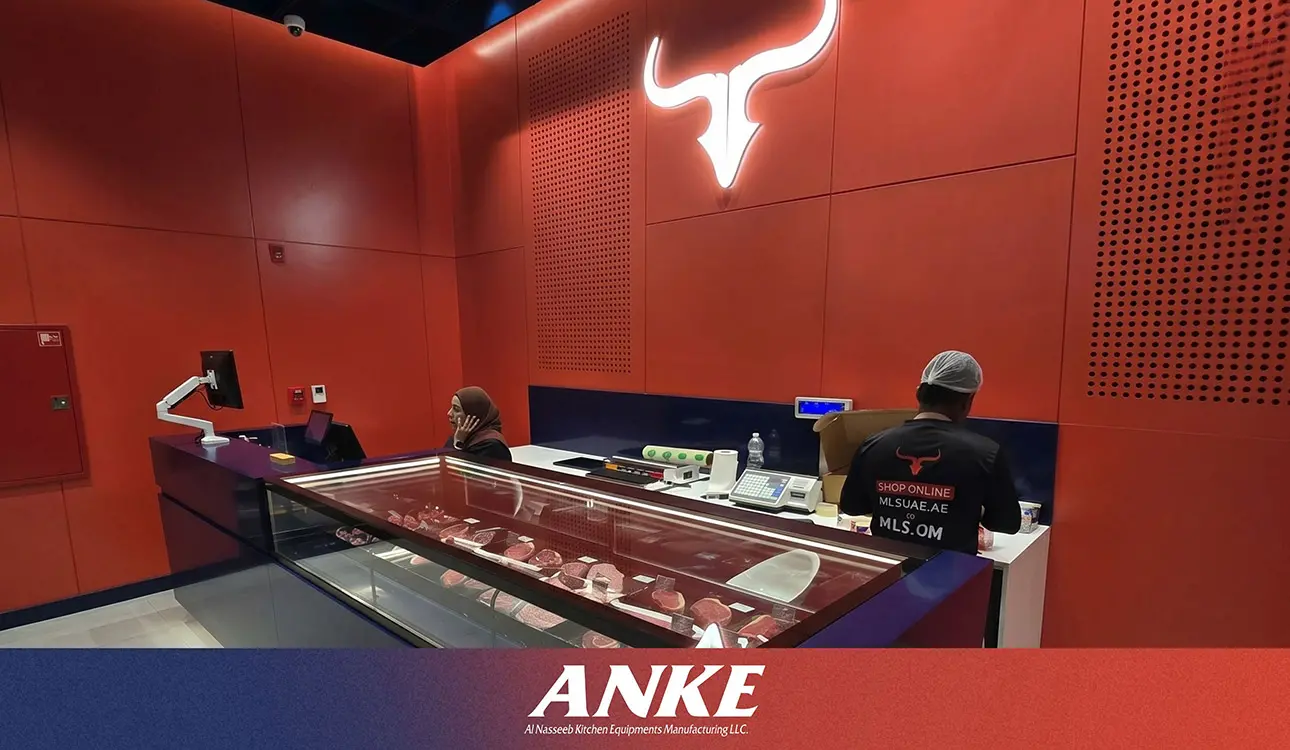
There is no single fixed price for a custom commercial meat display. ANKE prepares a project-specific quotation because the final scope changes with the display dimensions. product capacity, cabinet format, refrigeration and humidity systems, glass and finishes, and delivery and installation requirements.
Two displays with the same external length may still have different costs. One may be a standard multi-shelf unit, while another may include reinforced carcass-hanging components, individually illuminated shelves, insulated glass, humidity control and more complex site installation.
Butchery owners searching for a meat display price are usually given one of two things: a catalogue sticker figure from an imported distributor, or a vague request to call for a quote. Neither tells the buyer what they are actually paying for, why the figures differ, or how to compare two proposals for the same floor space.
One ventilation failure in an incorrectly specified unit can spoil close to AED 6,000 of stock in 3 to 4 days. That single failure can exceed the price difference between a catalogue cabinet and a custom-fabricated display designed for UAE operating conditions.
This article explains the six quotation factors, why catalogue prices describe a different product, what running costs a butchery should budget for, and what ANKE needs to prepare an accurate written quotation .
What Determines the Cost of a Commercial Meat Display in Dubai?
Your quotation depends on six engineering variables. Each one changes the fabrication scope, the refrigeration requirement, and the installation cost. Here is how they break down:
| Factor | What changes in your quote |
| Size and capacity | Dimensions, usable display area, shelves and storage |
| Display format | Serve-over, upright, freestanding, self-service or carcass-hanging |
| Refrigeration system | Static or fan-assisted; remote or self-contained; refrigerant type |
| Humidity and moisture control | Humidifier, controls, water provision, drainage and cleaning |
| Glass, materials and finishes | Glass type, shelf lighting, steel grade, colour and cladding |
| Delivery, installation and site | Site access, utilities, lifting, testing and commissioning |
1. How Do Size and Display Capacity Affect the Quote?
Larger displays need more steel, more refrigeration, and more internal components. Your display size changes the fabrication scope, not just the cabinet dimensions.
Here is what size drives in your quote:
- Width and depth: More material, more insulation, and a larger compressor.
- Shelf count: More shelves mean more internal lighting, drainage channels, and airflow management.
- Modular layouts: Interchangeable shelf-and-hook systems add engineering inside the same footprint.
- Custom runs: Non-standard lengths need bespoke metalwork and refrigeration calculations.
Why external size does not tell you the full cost
In one ANKE-fabricated upright meat display for MLS Butchery in Dubai Motor City, the visible cabinet dimensions were only one part of the engineering scope. The unit contained approximately seven individually illuminated shelves, while the internal system could also be converted for carcass hanging. Top-mounted hooks were designed to carry lamb carcasses of approximately 50 kg, and the cabinet included two minimal-frame sliding doors.
This means two displays with similar external dimensions can require different structural reinforcement, lighting, internal fittings and refrigeration calculations.
For layout planning, see our commercial meat display size guide.
2. How Does the Display Format Affect the Quote?
Display format determines the structural load, the door arrangement, and the staff-access design. A carcass-hanging display requires different engineering than a serve-over counter.
Common formats and what each adds to your quote:
- Serve-over counter: Glass box, front staff access, and hinged or sliding rear doors.
- Upright display: Taller frame, vertical refrigeration coils, and more glass area.
- Freestanding unit: Standalone base, four-side glass, and higher visual impact.
- Carcass-hanging section: Reinforced top structure to support whole carcasses.
For MLS Butchery, ANKE did not quote one repeated standard cabinet. The project combined an upright multi-shelf display, an upright unit with a carcass-hanging section and a freestanding customer-facing counter.
Each unit served a different merchandising role. The carcass display required a different internal and structural configuration from the shelf display, while the freestanding counter required its own glass-box construction and black border printing. This is why a per-metre catalogue price would not accurately describe the full project.
For a comparison of display types, see the key features of a commercial meat display.
3. How Does the Refrigeration System Affect the Quote?
Your refrigeration choice determines the compressor type, the refrigerant, the airflow design, and the installation method. Each choice changes both the purchase price and the running cost.
Here is what ANKE builds with:
- R290 refrigerant: A natural refrigerant rated for high ambient temperatures in UAE retail environments.
- Climate Class 5 compressors: Designed to cycle efficiently in Dubai’s heat, reducing electricity draw.
- Fan-assisted cooling: Recovers cabinet temperature quickly after door openings. Suited for fresh red meat in high-traffic butcheries.
- Static cooling: Circulates less air. Suited for marinated products and kebabs where fan airflow risks drying the surface.
ANKE uses static cooling for products such as marinated kebabs and skewers where continuous fan airflow may dry the surface coating. Static systems cool without fans, creating gentler air movement around the displayed product.
A high-traffic fresh-meat display may need a different temperature-recovery strategy. The quotation therefore changes according to what the customer will display and how frequently the cabinet will be opened, not simply the cabinet length.
4. How Do Humidity and Moisture-Control Features Affect the Quote?
Humidity control adds a humidifier, controls, water provision, drainage, and commissioning to your quotation. It is a separate factor, not a refrigeration sub-feature.
Here is what humidity control adds to your project:
- Humidifier unit: Adds to fabrication cost and cabinet depth.
- Water provision: Requires a direct connection or a reservoir, depending on the installation.
- Drainage point: Needs site coordination during installation.
- Cleaning and commissioning: Adds to the handover scope and the ongoing maintenance schedule.
ANKE integrates humidity control where the product and operating conditions require it. According to the company’s fabrication team, freshly cut meat can lose surface moisture while cooling, affecting its visible freshness. Adding a humidifier changes more than the equipment list: it may require water provision, drainage, controls, cleaning access and commissioning.
5. How Do Glass, Materials, Lighting and Finishes Affect the Quote?
Glass type and finish colour change the fabrication cost, the thermal performance, and the look of your display in-store. These are real cost lines, not cosmetic choices.
Here is what ANKE builds with:
- 304-grade stainless steel: Hygienic, strong, and corrosion-resistant.
- Argon-filled insulated glass: Reduces heat gain through the door panel. Lowers compressor load. Supports 0 to 4 degrees C for fresh red meat.
- Frameless or low-frame glass: Maximises product visibility from the front.
- Custom powder-coat finish: Any colour. The MLS units were finished in matte black.
- Printed glass borders: The MLS freestanding counter used black border printing on the glass box.
For temperature compliance guidance, see our article on meat display temperature and food safety.
6. How Do Delivery, Installation and Site Conditions Affect the Quote?
Delivery location, site access, and on-site requirements all change your final quotation. A unit with remote refrigeration or a humidifier needs more site coordination than a standard self-contained display.
Here is what adds to your installation scope:
- Remote refrigeration: Requires pipework and a separate plant-room connection.
- Humidifier: Needs a water supply and a drainage point on-site.
- Large upright displays: Require lifting access and fit-out coordination.
- Commissioning: Covers testing, quality checks, and handover to your team.
Confirm with ANKE which services are included in your quotation before ordering.
How Poor Ventilation Led to Almost AED 6,000 in Stock Loss
A client came to ANKE after an existing refrigerated display repeatedly overheated.
- The problem: The compressor compartment had too little ventilation. Fresh air could not enter properly, and hot air had no clear route to escape.
- What happened: Heat built up around the condensing unit. Within three to four days, the refrigeration system failed and almost AED 6,000 worth of stock was lost.
- What ANKE changed: ANKE redesigned the solution with:
- Dedicated fresh-air intake space
- Rear ventilation openings for hot-air exhaust
- Better airflow around the compressor compartment
- Why this affects the quotation: Ventilation may look like a small installation detail, but it directly affects equipment reliability and stock protection. A correctly designed airflow system can add to the fabrication and site-planning scope, while helping prevent overheating, breakdowns and product loss.
Why Is a Catalogue Price Different From a Custom Quotation?
A catalogue price covers one standard cabinet. A custom ANKE quotation covers your project, from site-specific sizing to commissioning. The two figures describe different scopes of work.
Here is the difference:
| Specification | Catalogue display | ANKE custom quotation |
| Sizing | Fixed standard dimensions | Site-specific layout and run |
| Cooling system | Pre-set specification | Product-matched: static or fan-assisted |
| Humidity control | Not typically included | Integrated humidifier, controls and drainage |
| Glass | Standard single-pane or curved | Argon-filled insulated, frameless or printed |
| Finish | Catalogue colour options | Store-matched powder coat and cladding |
| Delivery and install | Delivery only (typically) | Delivery, installation and commissioning |
| Price basis | Published sticker price | Written project quotation |
For a full analysis, see our article on the hidden cost of standard display counters.
What Does It Cost to Run a Commercial Meat Display?
Running cost is the second figure you need to budget for. A meat display runs 24 hours a day, every day of the year.
Here is what drives your running cost:
- Refrigerant: R290 performs efficiently in Dubai’s heat. Older R404a units draw more power in high ambient temperatures.
- Compressor: Climate Class 5 compressors cycle less in UAE conditions. This reduces your electricity consumption.
- Glass: Argon-filled insulated glass reduces heat gain through the door. This lowers the compressor workload.
- Humidity system: Your humidifier needs regular maintenance, water management, and cleaning. Add this to your operating budget.
Pro Tip: At 0.38 AED per kWh, every 1 kWh your display avoids per day equals 139 AED per year per unit. Ask your fabricator for the rated daily power consumption and the compressor’s climate-class rating before ordering.
For more guidance, see our article on energy-efficient commercial refrigeration in the UAE.
What Should You Include in a Quotation Request?
Use our commercial meat display size guide for layout decisions. Then prepare these seven details before contacting ANKE:
- Display dimensions: Width, depth, height, and available floor space. Include aisle width and ventilation clearance.
- Product range: Fresh red meat, marinated products, poultry, or a combination.
- Display format: Serve-over counter, upright cabinet, freestanding unit, or a carcass-hanging section.
- Shelf or hanging configuration: Fixed shelves, adjustable shelves, or an interchangeable modular layout.
- Cooling and humidity preference: Static or fan-assisted cooling. Whether a humidifier is required.
- Glass and finish: Glass type, finish colour, and any branded cladding or printing.
- Site details: Electrical supply, drainage, site access, and required completion date.
Pro Tip: Budget for energy-efficient refrigeration at the start. Retrofitting efficiency after purchase is rarely possible.
How Does ANKE Build a Custom Meat Display for a Butchery?
ANKE International designs and fabricates custom refrigerated meat display counters for butcheries, supermarkets, and premium food retailers in Dubai and the UAE. At ANKE, we configure every display around your product, your space, and your brand.
- Custom fabrication: Built to your floor plan at our Ajman facility, not a catalogue dimension.
- R290 refrigeration: Climate Class 5 compressors rated for UAE operating conditions.
- Argon-filled insulated glass: For product visibility and stable thermal performance.
- ISO 9001 and HACCP certified: Meeting Dubai Municipality food safety standards.
- 1-year manufacturer warranty: On every custom display we ship.
- 4 to 6 week lead time: From order to handover in Dubai.
| Completed project: MLS Motor City, Dubai
ANKE delivered three display types for MLS Butchery, all finished in matte black with argon-filled insulated glass. The modular interior system allows shelves and carcass-hanging components to be interchanged as merchandising requirements change. |
See the full project at the MLS Motor City meat display case study.
Summary
A commercial meat display quotation in Dubai covers six project-specific factors, not a single catalogue figure. Understanding those six factors helps you evaluate competing proposals, plan your running costs, and commission a display that works for your butchery across its full operating life.
ANKE International prepares written quotations for butcheries in Dubai and the UAE. Your quotation covers display size, format, refrigeration system, humidity control, glass and finishes, and installation scope.
Contact ANKE today for a free consultation.
Commercial Meat Display Cost in Dubai: Frequently Asked Questions
How much does a commercial meat display cost in Dubai?
ANKE prepares project-specific written quotations for commercial meat displays in Dubai because cost depends on six factors: display size and capacity, format, refrigeration system, humidity control, glass and finishes, and installation scope. Contact ANKE for a written quotation for your butchery.
Why does ANKE not publish a standard price?
Two displays of similar external length can carry different refrigeration systems, humidity control, glass types, and installation requirements. Each difference changes the quotation total. A single sticker price cannot cover that range.
What is the difference between a catalogue display and a custom ANKE quotation?
A catalogue display ships with fixed dimensions and a pre-set specification. An ANKE custom quotation covers site-specific sizing, product-matched cooling, humidity control, specialist glass, store-matched finishes, and commissioning. The two figures describe different scopes of work.
Does humidity control affect the price of a meat display?
Yes. A humidifier, controls, water provision, drainage, cleaning, and commissioning all add to the quotation scope. ANKE treats humidity control as a separate quotation factor because it changes both the fabrication requirement and the ongoing maintenance commitment.
How does cooling type affect meat presentation?
Fan-assisted cooling recovers cabinet temperature quickly after door openings. It suits fresh red meat in high-traffic displays. Static cooling circulates less air. It suits marinated products and kebabs where airflow risks drying the surface. The right choice depends on your product range, not on price.
What information do I need to provide for a quotation?
Provide display dimensions, product range, format requirements, cooling preferences, shelf or hanging configuration, glass and finish choices, delivery location, site access, electrical supply, drainage availability, and required completion date.
How long does fabrication take?
ANKE fabricates custom meat displays in Ajman in 4 to 6 weeks from order to handover. The lead time covers design confirmation, fabrication, quality checks, and delivery. Every unit ships with a 1-year manufacturer warranty.
